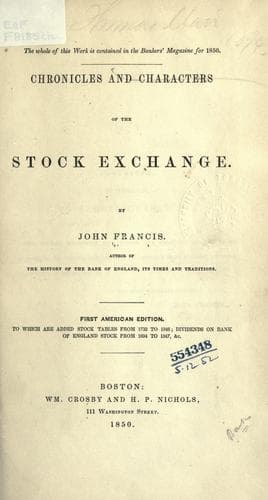
Chronicles and characters of the stock exchangeFrancis, John, of the Bank of England
History
Chronicles and characters of the stock exchange
Francis, John, of the Bank of England
Speculation; Stock Exchange (London, England)
During the loans so frequently mentioned, it was curious to witness
the bidders arising at early dawn; waiting from two until ten in the
morning, and then see them rush, with all the eager impetuosity of
gain, to grasp a share of the proffered good.
When it became known that, on the 12th of May, 1789, an insurrection
had broken out at Paris, it was but little imagined that its effects
would press upon the resources of England for ever, increase her
taxation, and embarrass her councils; and as news came from time to
time of the excesses of the mob, the destruction of the Bastille, and
the murder of the monarch, it was received in accordance with the
political principles of the listener.
The first effect of the revolution shook the state to its foundation.
A strong democratic tendency passed through Europe, and England
shared the peril. A feeling of public wrong was prevalent. A fierce
movement convulsed the populace. Debating societies were established,
and the misgovernment of the nation was exposed. The public-houses
were filled with orators, and the cry for reform was incessant. The
press teemed with warnings and appeals. Societies corresponding with
the Jacobin clubs of Paris were established. Some of the first men
in England welcomed the revolution with enthusiasm, while the masses
hailed it with delight. The Convention was congratulated; and it is
surprising that, with democratic principles, a democratic spirit, and
a numerous array of men of rank on the popular side, England should
have preserved her constitution.
William Pitt, the minister of the day, took a bold and determined
position. “It is not reform they want,” he said, “it is revolution.
They wish to react the troubles of France; to murder the king; and
establish a republic.” The people petitioned, and were neglected.
They agitated, and were punished. The youth of England clamored for
more freedom; and revolutionary principles spread far and wide.
Persons of rank and property were alarmed, and formed associations
against anarchists and levellers. Parliament was summoned before its
time; the Alien Bill was passed; the naval and military forces were
augmented; and when the French Convention declared they would assist
the disaffected subjects of all monarchical governments, the English
ministry demanded a disavowal. The demand was refused; the French
ambassador was ordered to leave the kingdom; and, in 1793, the war
which added so terribly to England’s encumbrances was declared.
Public-domain text, read in full here on John Shaqi.
Reviews
Reviews
No reviews yet
Be the first to share your thoughts on this work.
Elsewhere in the archive
Join the Discussion
Join the discussion
Sign in to leave a comment or review.
Sign InorCreate an account