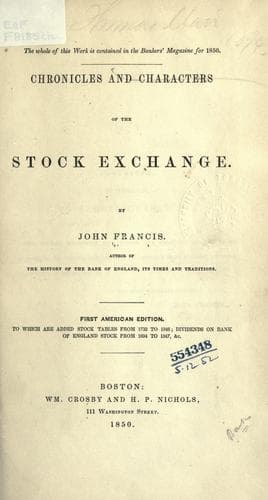
Chronicles and characters of the stock exchangeFrancis, John, of the Bank of England
History
Chronicles and characters of the stock exchange
Francis, John, of the Bank of England
Speculation; Stock Exchange (London, England)
But though England witnessed the power of the republic aggrandized
on the Continent,—though the blood she had shed and the money she
had spent were ineffectual on land,—she yet retained her ancient
supremacy at sea. The name of Nelson was a word of dread; and the
maritime force of France was crushed by that victory which crowned
a series of splendid successes in the Bay of Aboukir, and which,
known as the battle of the Nile, went like a trumpet call throughout
Europe. The despondency of the Continent passed away; the system
of coalition, so dear to William Pitt, was again called forth; and
Austria, Russia, Turkey, and Naples once more joined the victorious
island. Loans were again made. Germany had another million, Russia
half that amount, and other sums passed to other powers. But the
exertion was vain, the loans were fruitless; and in 1802 that peace,
of which it was said “every man is glad, but no man is proud,” was
concluded in the treaty of Amiens.
In the same year the sinking funds were united, to assist in
discharging the debts then existing; and one per cent. on loans
subsequent to 1802 was again appointed, to swell the amount. This
fund at its commencement was limited to four millions, but this
limitation was repealed; and the application of expired annuities,
and of saving by the reduction of interest, was also repealed.
In the latter part of the century, a beneficial change was made
in the provision for the naval expenses. Prior to this period, £4
per man per month was the allowance to meet the entire cost of the
department; after this time, the expenses of the navy were supplied,
like other charges, from the loans periodically raised.
Though the discontent of the English people was often roused, yet
the stories which were occasionally circulated,—of forced loans in
France,—of Parisian banking-houses being surrounded by soldiers,—of
money-chests violated, and of moneyed men plundered,—had considerable
effect in quieting them. It is probable that many of these were
inventions; some of them were understood to be so; but when it is
known that entire yearly incomes were often collected, and called
income-tax, there are few financial follies of our neighbours which
we should not be inclined to credit.
A curious proposition to pay off the national debt was very seriously
made in 1798. A profound disquisition upon the evils which arose
from it, and the ruin to which it was leading, was followed by an
intricate array of figures, a close calculation of the population,
and an analysis of their incomes. Somewhat excited by the grave
beginning, the public were not a little disappointed to find that,
by deducting one day’s provision per week for a certain time, and
allowing compound interest on it, the great financial difficulty
of the day might be overcome. The volume was privately printed,
in quarto, at considerable expense; but whether it emanated from
a lunatic asylum, or whether it sent the writer to one, cannot be
ascertained.
Public-domain text, read in full here on John Shaqi.
Reviews
Reviews
No reviews yet
Be the first to share your thoughts on this work.
Elsewhere in the archive
Join the Discussion
Join the discussion
Sign in to leave a comment or review.
Sign InorCreate an account