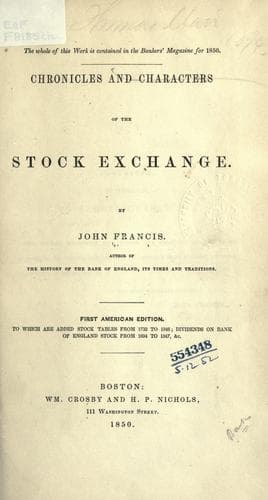
Chronicles and characters of the stock exchangeFrancis, John, of the Bank of England
History
Chronicles and characters of the stock exchange
Francis, John, of the Bank of England
Speculation; Stock Exchange (London, England)
It must be evident from the brief record of the war just given, that
business in the funds had increased greatly. Prior to 1801, the
market of ’Change Alley, in the coffee-house where the brokers met,
was, as a public place, open to any who chose to make it his resort.
The jobber who reckoned his transactions by hundreds of thousands was
jostled by the man who was disposed, either morally or materially, to
pick pockets; while the loans which had increased the national debt
to 550 millions, the exchequer-bills, which were circulated as freely
as the government dared, and the companies, which were augmented in
proportion, formed an amount of business that, in the opinion of the
principal persons, demanded a building to bear some proportion to
the importance of its transactions. It was resolved, therefore, to
choose a plot of ground as near the Bank as possible, and to meet
the required expenses by private subscription. Whatever errors may
be indigenous to the Stock Exchange, illiberality can scarcely be
classed among them; and so successful were the proceedings, that, on
the 18th of May, 1801, Mr. William Hammond, chairman of the committee
of management, laid the first stone of the first building erected
exclusively for the business of the Stock Exchange. Beneath the stone
the following inscription, engraved on copper, was placed:—
“On the 18th of May, in the year 1801, and forty-one of George
III., the first stone of this building, erected by private
subscription, for the transaction of business in the public
funds, was laid in the presence of the proprietors, and under
the direction of William Hammond, William Steer, Thomas Roberts,
Griffith Jones, William Grey, Isaac Hensley, Jo. Brackshaw, John
Capel, and John Barnes, managers; James Peacock, architect. At this
era, the first of the Union between Great Britain and Ireland, the
public funded debt had accumulated in five successive reigns to
£552,730,924. The inviolate faith of the British nation, and the
principles of the constitution, sanction and secure the property
embarked in this undertaking. May the blessing of that constitution
be secured to the latest posterity!”
To secure respectability in the members, vote by ballot was adopted,
and ten guineas per annum fixed on as the subscription.
The peace of 1801 was a welcome respite to all save the members of
the Stock Exchange; where it was said, “There were not commissions
sufficient to pay for summer excursions, nor confidence enough to
make a bankrupt.” Great efforts had been made to reduce the price,
which continued to ascend; although Goldsmid was said to have stood
in the market and sold to any amount at the lowest price of the time.
The attempt proved vain; and the endeavour to control public opinion
was paid for by this house to the amount of £180,000.
Public-domain text, read in full here on John Shaqi.
Reviews
Reviews
No reviews yet
Be the first to share your thoughts on this work.
Elsewhere in the archive
Join the Discussion
Join the discussion
Sign in to leave a comment or review.
Sign InorCreate an account