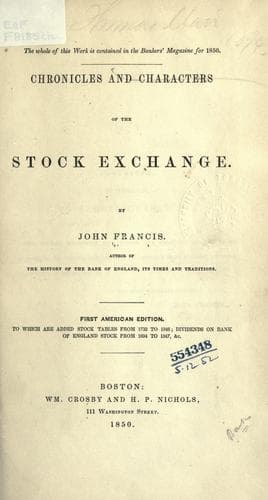
Chronicles and characters of the stock exchangeFrancis, John, of the Bank of England
History
Chronicles and characters of the stock exchange
Francis, John, of the Bank of England
Speculation; Stock Exchange (London, England)
It was difficult to believe, at first, that war had really ceased.
There was a continued excitement until the treaty was signed; all
places of public resort were thronged with inquirers; betting ran
high about the articles; the chances of exchequer-bills and new
lotteries were discussed; and when the truce was announced in the
city, it was also announced that the preliminaries of a new loan
would be arranged. Talleyrand was talked of as having employed
his information and capacity in gaining large sums; foreigners
generally were busy in making or marring their fortunes; and it was
ascertained that, in 1803, they held upwards of eighteen millions of
government securities. When it was known that the preliminaries were
signed, the tumultuous joy of the nation is beyond expression; and
Lloyd’s was instantly crowded. The people ran about, congratulating
one another on the happy event; the different steeples displayed the
union-flag by day, and at night a general illumination took place;
consols rose from 59 to 66½, and there were twenty-one defaulters on
the next settling day.
The loan, known as the loyalty loan, attracted much attention in the
early part of the century. The period at which it was contracted
was a critical one for the empire. Abroad, Prussia and the princes
of the Empire had withdrawn from the confederacy against France;
Austria demanded assistance; Holland was bound by fear to the
French republic. Stagnation of trade, scarcity of specie, want of
provisions, and discontent among the people, marked the period at
home. The supplies for the year were difficult to obtain; an appeal
was made to the loyalty of the nation, and that appeal was answered.
Some subscribed in the hope of gain; others to curry favor; and,
with all these various interests, eighteen millions were subscribed
in a few days. As an additional inducement, it was promised that
the capital, if claimed, should be repaid within two years after a
definitive treaty of peace. The peace of Amiens came in 1802, and
the holders were, therefore, entitled to demand, on the 27th of
March, 1804, £100 sterling for each £100 stock, although the latter
was at a heavy discount. It need hardly be added, that the claim was
made; and, as money was not sufficiently plentiful, it was arranged
that, for every £100 of the three per cent. loyalty loan, £100 Navy
five per cent. should be given, and for the difference between the
money-price of the latter and £100 sterling, the holder should
receive the amount in three per cents. The whole entailed a heavy
loss upon the country, and this was more to be regretted, because
upwards of eight millions of this loan had been gathered by the Jews,
and by two city banking-houses.
Public-domain text, read in full here on John Shaqi.
Reviews
Reviews
No reviews yet
Be the first to share your thoughts on this work.
Elsewhere in the archive
Join the Discussion
Join the discussion
Sign in to leave a comment or review.
Sign InorCreate an account