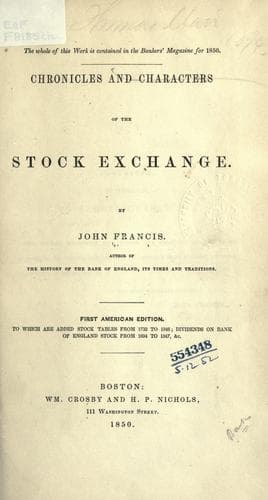
Chronicles and characters of the stock exchangeFrancis, John, of the Bank of England
History
Chronicles and characters of the stock exchange
Francis, John, of the Bank of England
Speculation; Stock Exchange (London, England)
“Whereas divers brokers and stock-jobbers have lately set up and
carried on most unjust practices, in selling and discounting tallies,
bank-stock, bank-bills, shares and interest on joint stock, and
other matters, and have and do unlawfully combine to raise or fall
the value of such securities, for their own private advantage; and
whereas the numbers of such brokers and stock-brokers are very much
increased within these few years, and do daily multiply,—be it
enacted, that from and after May, 1697, no person shall act as broker
until licensed by the Lord Mayor and Court of Aldermen of the said
city of London.
“That the number of brokers shall not exceed one hundred, and that
the admittance fees shall not exceed 40_s._
“That the names of the brokers shall be publicly affixed on the Royal
Exchange, in Guildhall, and other public places in the city.
“That any persons acting as brokers without being admitted as
aforesaid, shall forfeit £500, and persons employing them £50; and
that any person not being a sworn broker acting as such, shall
forfeit £500, and for every offence stand three times in the pillory.
“That all brokers shall keep a book, to be called the Brokers’-book,
to enter contracts, and in cases of omission, forfeit £50 for every
offence.
“That they shall not receive more than ten shillings per cent. for
brokerage. That, if they shall deal in any articles on their own
account, they shall forfeit £500, and never act as brokers again.
“That no person buying or selling tallies, corn, or any other
provision, or coal, shall be esteemed a broker within the meaning of
the act.”
In 1707, this, which was for ten years, expired; and although
various petitions, according to the interest of the petitioner, were
presented, it was not renewed. A new act was then brought in, by
which a yearly tax of forty shillings was levied against all brokers;
and it is doubtful whether this would have been passed, had not a
deficiency been created by the repeal of one concerning specie.
In 1711, a committee of the House was appointed to consider the acts
relative to brokers; and a recommendation ensued to revive the act of
1697. In compliance with this, a bill was brought in, read a first
and second time, but was not passed; and in the reign of Queen Anne,
the charge for brokerage of 10_s._ per cent. was reduced to 2_s._
9_d._ It is now 2_s._ 6_d._
In 1746, and in 1756, new bills were brought in, but rejected, which
materially affected stock-jobbers; and in 1765 it was ordered that
a bill be brought in to restrain the ill practices of brokers; but
this, like the others, was not passed.
Public-domain text, read in full here on John Shaqi.
Reviews
Reviews
No reviews yet
Be the first to share your thoughts on this work.
Elsewhere in the archive
Join the Discussion
Join the discussion
Sign in to leave a comment or review.
Sign InorCreate an account