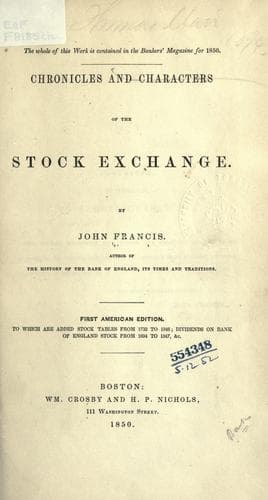
Chronicles and characters of the stock exchangeFrancis, John, of the Bank of England
History
Chronicles and characters of the stock exchange
Francis, John, of the Bank of England
Speculation; Stock Exchange (London, England)
The ground of defence occupied by Mr. Baily was somewhat subtle. In
1806, this gentleman published a pamphlet, called “The Rights of
Stock-jobbers defended,” in which he explained his principles of
action, and detailed the course which had been taken. He says:—“The
right of the city of London to call upon stock-brokers to be sworn
in before the Court of Aldermen, has long been contested and opposed
by that body. It is resisted by them, in the first instance, under
the impression that they are merely agents, and ought not to be
considered as brokers more than many other persons, who, under the
name of tailors, merchants, and tradesmen, act by commission in the
purchase and sale of goods.”
With these ideas Mr. Baily contested the right, not, as those who
knew him will readily credit, from narrow views or confined notions,
but because he believed he was supporting a principle founded in
justice. These views, however, he found it impossible to maintain. A
case was produced by the city, in which it was decided that a person
buying and selling stock came within the meaning of the act; and the
efforts of Mr. Baily proved futile.
For those who feel disposed to investigate the subject, a list of
acts relating to brokers will be found in the Appendix.
In 1807, Lord Henry Petty proposed a new plan for a sinking fund;
which, however, was only a revival of the principle of borrowing with
one hand and spending with the other; and, as the ministry which
planned it were not long in office, it was not continued after the
first year.
CHAPTER XI.
_Unfounded Charge.—Joint-Stock Companies.—Speculators.—Mark
Sprot.—Sketch of the House of Baring.—Policies on the Life
of Bonaparte.—Rumors of his Death.—David Ricardo.—Forgery of
Benjamin Walsh.—Excitement of the Nation.—Increase of the National
Debt.—Sinking Fund.—Unclaimed Dividends.—Francis Baily._
Although shares in life assurance companies form part of the
professed business of the Stock Exchange, yet the better class rarely
reach the hands of the brokers. They are held in such high and
deserved estimation, that they remain in the possession of families
for generations, passing as heirlooms, with the same confidence in
their value as if they were freehold. As an instance of this, it was
noticed in the papers that the first public sale of the stock of the
Royal Exchange Assurance Corporation occurred in 1812.
Public-domain text, read in full here on John Shaqi.
Reviews
Reviews
No reviews yet
Be the first to share your thoughts on this work.
Elsewhere in the archive
Join the Discussion
Join the discussion
Sign in to leave a comment or review.
Sign InorCreate an account