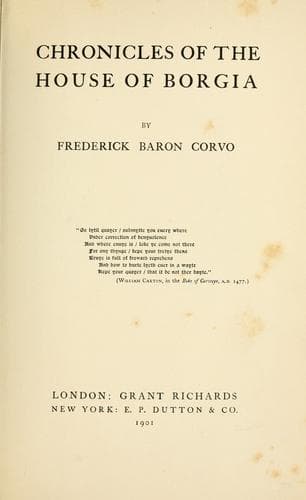
Borgia family; Borja, Francisco de, Saint, 1510-1572; Italy -- History -- 1492-1559
Florence, capital city of Tuscany and ancient friend of France, was in a
critical condition. Lorenzo de’ Medici was just dead. His son, Don Piero
had succeeded him. Don Piero’s brother Messer Giovanni, raised to the
purple at the age of thirteen years, red-hatted at seventeen, was a
Cardinal of Rome. The genius of the great Lorenzo had made him disguise
his power. He had married at his own mother’s bidding Madonna Clarice
Orsini, a patrician of Rome. His sons, educated by Canon Angelo
Ambrogini (detto Poliziano), had grown up intellectual, grand, and gay,
with an overweening sense of their own consequence; and, when the
sceptre fell into his young inexperienced hands, Don Piero forgot his
father’s advice, “Remember that thou art but a citizen of Florence, even
as am I;” and he behaved autocratically, despotically, independently, to
the immense antipathy of the Lily-City.
When the Majesty of France began his interference with Italian politics,
Don Piero de’ Medici and Florence, being contracted to the Regno,
declined the offer of a French alliance. The Christian King retorted by
banishing Florentine merchants from France. This gave occasion for the
enemies, (which, in common with all great Houses, Medici had) to
blaspheme, muttering of the evils of a tyranny, of the advantages of a
republic: and Don Piero’s cousins, Don Giovanni and Don Lorenzino, fled
to the Christian King at Piacenza; saying that not Florence, but Don
Piero only, was the foe of France.
Fra Girolamo Savonarola, friar of the Religion of St. Dominic, became a
prominent and responsible figure in this imbroglio. Ecclesiastically he
was a subject of the Dominican Congregation of Lombardy, who was led to
desire independence and a pied à terre in Florence. Don Piero de’
Medici, seeing naught amiss, supported his application to Rome for the
separation of the Tuscan Dominicans from allegiance to the Lombard
Congregation; for, it was urged, the erection of a separate Congregation
for Lombardy would add to the dignity of Florence, and would be a slight
to Milan. The Lord Alexander P.P. VI, when the case was laid before Him
in 1493, was inclined to favour Milan on account of the
Vicechancellor-Cardinal who was brother to the usurping Regent: but, on
the advice of Cardinal Oliviero Carafa, who officially had examined the
matter on its merits, and who reported in favour of Don Piero de’ Medici
and the weird friar, the Pope’s Holiness issued the Bull of Separation
on the twenty-second of May that same year. Fra Girolamo Savonarola then
transferred himself to the new Tuscan Congregation, was elected Prior of
San Marco and Vicar-General; and so became the absolute ruler of the
Dominicans in Florence, and subject only to the General of the Religion
of St. Dominic, and to the Pope, in Rome.
Public-domain text, read in full here on John Shaqi.
Reviews
Reviews
No reviews yet
Be the first to share your thoughts on this work.
Elsewhere in the archive
Join the Discussion
Join the discussion
Sign in to leave a comment or review.
Sign InorCreate an account