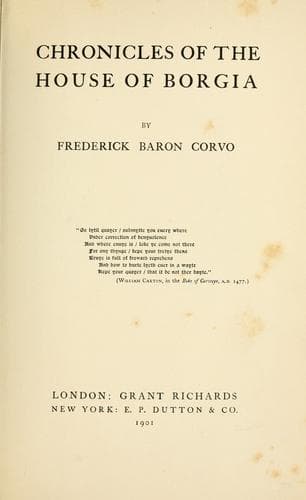
Borgia family; Borja, Francisco de, Saint, 1510-1572; Italy -- History -- 1492-1559
The Lord Alexander P.P. VI had now reached the summit of His magnificent
pontificate. With the States of the Church slowly but surely being
brought under domination by the splendid gains of Duke Cesare de
Valentinois, with the interested support of the Christian King of France
and the Catholic King of Spain, (for the latter had the sense to cease
from annoying a powerful pontiff), and with His neighbour the Regno
under its weak King Don Federigo of no importance, there was nothing
that He might not do for the enrichment of the Papacy or the
aggrandisement of the House of Borgia. His policy was beginning to take
shape. The enormous and magnificent project, which appears to have
dictated all His actions, was assuming a concrete form. Difficulties of
every kind had beset Him from the beginning; and difficulties, He
doubtless knew, would be His constant portion: but by patience, agility
of mind, diplomatic skill, singleness of purpose, and His invincible
indomitable will, He had beaten down His opponents one by one, or had
turned their opposition into support which now enabled Him to act
independently and upon His own initiative.
He made short work with the rebellious barons of Rome. He blasted Don
Pierfrancesco Colonna with excommunication. He confiscated the fiefs of
the Houses of Colonna and Savelli, both of the Ghibelline faction, who
had defied Him by secession to Charles VIII and the unmitigable Cardinal
Giuliano della Rovere in 1494. He distributed the titles and estates so
acquired among members of the House of Borgia.
On the first of September 1501, He issued a Brief legitimating that
bastard of Duke Cesare de Valentinois and a Roman spinster, who had been
born in 1498, and was known as Infans Romanus; to whom He gave the name
Giovanni, after His favourite son the murdered Duke of Gandia, as well
as the duchy of Nepi. But, by a second Brief of the same date (in the
Archives of Modena) He declares this Don Giovanni Borgia to be the son
_not of the aforesaid Duke (Cesare) but of_ US _and the said
spinster_.[46]
There exists no explanation of the contradiction in these two Briefs. It
is, however, certain that no human temptation could induce a Pope to
publish such a statement as that of the second, unless the thing were
true; and, in the case of a Pope as powerful as the Lord Alexander P.P.
VI, there was no superior power which could force Him against His will.
As to one of the Briefs being truth and the other falsehood, it may be
remembered that there is a general law, a Necessary Proposition, “The
lesser is contained in the greater.” The thing was true. The Lord
Alexander P.P. VI, at the age of sixty-seven years, was the father of
Don Giovanni Borgia, whom He created Duke of Nepi in 1501.
Public-domain text, read in full here on John Shaqi.
Reviews
Reviews
No reviews yet
Be the first to share your thoughts on this work.
Elsewhere in the archive
Join the Discussion
Join the discussion
Sign in to leave a comment or review.
Sign InorCreate an account