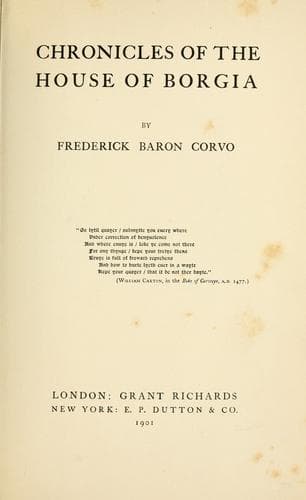
Borgia family; Borja, Francisco de, Saint, 1510-1572; Italy -- History -- 1492-1559
The Lord Alexander P.P. VI was a very great man; guilty of hiding none
of his human weakness: and on this account a Terror to hypocrites of all
ensuing ages. Nothing in the world is so unpleasant, so disconcerting,
so utterly abhorred, as the plain and naked truth.
* * * * *
After the spoliation of the Houses of Colonna and Savelli—an act which
reduced them from that of premier barons of the Holy See to a position
of such insignificance that they no more appear in the history of this
pontificate,—the Pope’s Holiness married Madonna Lucrezia Borgia to Don
Alfonso d’Este, the heir of Duke Ercole of Ferrara. This was after her
year of widowhood. She was now the wife of royalty, with a near prospect
of a throne, worshipped by the poor for her boundless and sympathetic
charity, by the learned for her intelligence, by her kin for her loving
loyalty, by her husband for her perfect wifehood and motherhood, by all
for her transcendent beauty and her spotless name. Why it has pleased
modern writers and painters to depict this pearl among women as a
“poison-bearing maenad” a “veneficous bacchante” stained with revolting
and unnatural turpitude, is one of those riddles to which there is no
key. If physiognomy be an index to character, the most superficial
inspection of the effigy of Madonna Lucrezia Borgia must put her
calumniators to endless shame. In that simple profile, of features
clean-cut, delicate, refined; in those chaste contours so gently
rounded, so sweetly fresh and feminine; in the carriage of that flavian
head well-poised and nobly frank, there can lurk no taint of decadent
degeneracy. In the Ambrosian Library at Milan, is a long tress of her
beautiful yellow hair, shining and pale; with her scholarly letters to a
learned poet and cardinal the Lord Pietro Bembo, who had dedicated to
her a genial Dialogue on platonics in Italian; an Elegy in Latin, in
praise of her singing and recitation,
“_quicquid agis, quicquid loqueris, delectat: et omnes
“praecedunt Charites, subsequiturque decor_;
with an Epigram on a gold serpent bracelet that she wore,
ARMILLA AUREA LUCRETIAE BORGIAE FERRARIAE DUCIS IN SERPENTIS EFFIGIEM
FORMATA
“_Dypsas eram: sum facta, Tago dum perluor, aurum
“tortile nympharum manibus decus; at memor dim
“Eridani, auditaque tua Lucretia forma,
“Eliadum ne te caperent electra tuarum,
“gestandum carae fluvius transmisit alumnae._”
Public-domain text, read in full here on John Shaqi.
Reviews
Reviews
No reviews yet
Be the first to share your thoughts on this work.
Elsewhere in the archive
Join the Discussion
Join the discussion
Sign in to leave a comment or review.
Sign InorCreate an account