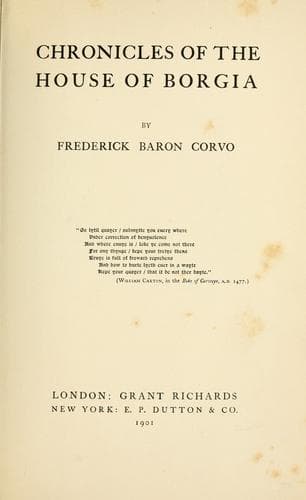
Borgia family; Borja, Francisco de, Saint, 1510-1572; Italy -- History -- 1492-1559
later must have been discovered? May I not trust the official accounts
of the Pope’s sickness, more than the mere rumours of the mob? That
official account declares the Pope to have died of a double-tertian
fever. There is not the slightest vestige of proof in favour of the
accusation which you have brought against His memory. His son
Borgia[67] happened to fall sick at the time when his Father died.
That is the sole foundation for the story of the venom.’”
It will appear that the death of the Lord Alexander P.P. VI, from venom,
is improbable. It may also be said that it was impossible, for reasons
here forthcoming.
The Legend of the Borgia Venom
One of the stock phrases used by biographers and historians of the
Fifteenth and Sixteenth Centuries was “he (or she)—died in the odour of
sanctity.” Another was “he (or she)—died not without suspicion of
venom.” Both phrases are the merest expression of private opinion, the
importance of which depends upon the integrity and knowledge of the
user: but in no case do they amount to a dogmatic, final, infallible, or
authoritative, decision.
When a person is said to have departed this life in the odour of
sanctity, (a purely technical phrase, insusceptible of literal
translation,) sooner or later the process of ecclesiastical law is begun
for obtaining for the deceased the successive titles, _Venerable Servant
of God_, _the Blessed ——_, and _Saint ——_. These titles, only being
conferred after stringent examination of quality lasting many years and
sometimes many centuries,[68] are taken to prove the pious opinion “died
in the odour of sanctity” to have been founded on a verity.
Public-domain text, read in full here on John Shaqi.
Reviews
Reviews
No reviews yet
Be the first to share your thoughts on this work.
Elsewhere in the archive
Join the Discussion
Join the discussion
Sign in to leave a comment or review.
Sign InorCreate an account