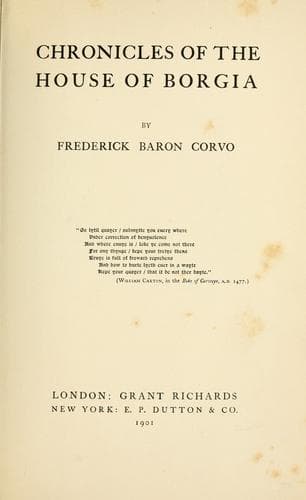
Borgia family; Borja, Francisco de, Saint, 1510-1572; Italy -- History -- 1492-1559
Herr Eugene Burckhardt’s very learned modern work, _The Civilization of
the Renaissance in Italy_, of which an English Translation is
accessible, is a case in point. It purports to be gravely written, and
is a mine of accurate information. Yet, among continuous ropes of pearls
of wisdom, occasionally one is startled by the discovery of a bead so
base, that one wonders how it has escaped detection and damnation. Here
is an example,
“Strictly speaking, as we are now discussing phases of Italian
civilization, this pontificate (1492–1503) might be passed over, since
the Borgia are no more Italian than the House of Naples. Alexander
spoke Spanish in public with Caesar; Lucrezia at her entry into
Ferrara, where she wore a Spanish costume, was sung to by Spanish
Buffoons: their confidential servants consisted of Spaniards, as did
most of the ill-famed company of the troops of Caesar in the war of
1500; and even his Hangman Don Michelotto, _and his Poisoner Sebastian
Pinzon_, seem to have been of the same nation.”
That is a specimen of the slipshod way in which serious writers are
false to their trust, of the half-truths which they make to serve for
the truth about the Borgia. It is exceedingly necessary to lay great
stress upon the Spanish origin of the Borgia, lest odium undeserved
should light on their adopted country Italy. They were very fine
examples of their race: but never let it be forgotten that their vices,
(for, being men, they had their vices) were Spanish and not Italian
vices. Herr Burckhardt does well to emphasize this fact, and to enrich
and illuminate it with a wealth of illustration: but when he comes to
speak of Don Michelotto as Duke Cesare’s Hangman, and of Sebastian
Pinzon as his Poisoner, with the light and easy freedom which one uses
in speaking of “the unquestioned things that are”; then one is compelled
to conjure up the horrible and fantastic picture of the Generalissimo of
the Pontifical Army stalking about the continent of Europe with an
official Hangman and an official Poisoner in his entourage. Don
Michelotto was a captain of Duke Cesare’s condottieri, a valued
confidential servant, perhaps, on sudden occasion, as at Sinigaglia, his
_executeur des hautes œuvres_: but never a professional Hangman. And
Sebastian Pinzon? Is it to be believed that Duke Cesare—for this really
is what Herr Burckhardt’s amazing statement implies—did so much
venenation in the way of business, that it was as necessary to have a
Lord High Poisoner attached to his staff as a Groom of the Stola or a
Clerk of the Hanaper?[69] The thing is absurd; worthy of comic opera,
not of serious history. But the origin of Herr Burckhardt’s error shall
be traced.
Public-domain text, read in full here on John Shaqi.
Reviews
Reviews
No reviews yet
Be the first to share your thoughts on this work.
Elsewhere in the archive
Join the Discussion
Join the discussion
Sign in to leave a comment or review.
Sign InorCreate an account