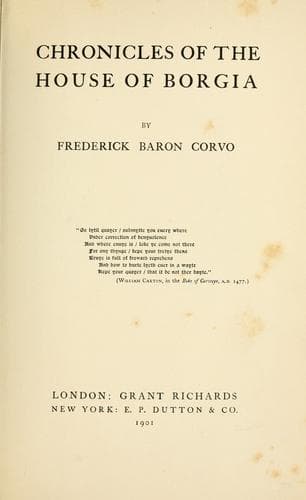
Borgia family; Borja, Francisco de, Saint, 1510-1572; Italy -- History -- 1492-1559
Of the cases named, Cardinal Giovanni Borgia (detto Giuniore), the
Sultan Djim, and Cardinal Orsini, are the most important. The
improbability in the case of the first already has been shewn: Duke
Cesare and he were friendly; their interests were asymptotic; and they
were apart during the seventeen days before the cardinal died. The
improbability in the case of the Sultan Djim lies in the fact that the
Pope lost 40,000 ducats annually, and the only means of keeping the
Turks from Christendom, by his death which was due to natural causes,
and took place when he was in the hands of the Christian King Charles
VIII at Naples, some weeks after he had left Rome. The improbability in
the case of Cardinal Orsini is proved by the tainted source from which
the charge emanated; by the publicity of all proceedings before and
after his death; and by the sworn testimony of his leeches. Cases of
this kind must be considered together; and rejected or accepted
together; for rumours do not gain credibility from vociferous
repetition: nor does it avail to plead that because advantages accrue
from the death of such a one, therefore, the person benefited by the
death is likely to have envenomed the deceased. Death is always
advantageous to some one living: but in no case named did the Lord
Alexander P.P. VI and Duke Cesare reap any gain whatever, but
contrariwise loss. As for the statement, that the venom of the Borgia
was a slow venom, slow in action, dirigible in absence, it safely may be
said that no such venom existed then any more than it does now.
This slow venom is an invention of purveyors of a certain class of
fiction, doing vast credit to their imaginative powers, but possessing
no tangible existence. These writers of fiction are merchants who must
supply their customers with goods upon demand. The Legend of the Borgia
Venom is a department of their trade. The public has read it and cried
for more according to the sample. The public is pleased to amuse itself.
At other times the public has the humour to inform itself; and takes
spiritual pastors, and masters, cunning in all learning, in all verities
of past and present. From these, the truth is required for mental
profit; from the others invention and imagination for mental recreation.
The public pays and has the right to choose what it will buy. A grocer,
who would venture to supply pickles instead of pepper ordered, would
encounter his patron’s discontent. A teacher, who would venture to
purvey fiction instead of fact required, would meet with similar
disaster, one would think. But in sober earnest, the Legend of the
Borgia Venom so very industriously has been propagated, that modern
serious writers have adopted it as one of the items which safely may be
included in their serious writings: and the public finding it there, in
places where truth is expected to be, looks upon the false as true
because it comes with the imprimatur of authority.
Public-domain text, read in full here on John Shaqi.
Reviews
Reviews
No reviews yet
Be the first to share your thoughts on this work.
Elsewhere in the archive
Join the Discussion
Join the discussion
Sign in to leave a comment or review.
Sign InorCreate an account