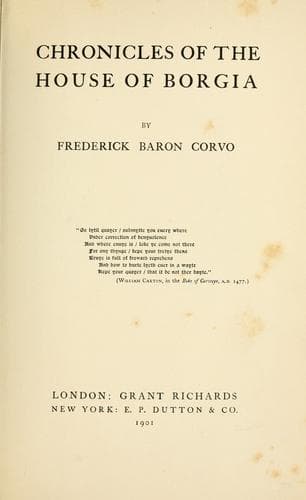
Borgia family; Borja, Francisco de, Saint, 1510-1572; Italy -- History -- 1492-1559
“The slave of his own appetites, in bondage to conventional laws, his
spirit emasculated by the indulgences, or corroded by the cares of
life, hardly daring to act, to think, or to speak, for himself;
man,—gregarious man,—worships the world in which he lives, adopts its
maxims, and treads its beaten paths. To rouse him from his lethargy,
and to give a new current to his thoughts, heroes appear from time to
time on the verge of his horizon; and hero-worship, Pagan or
Christian, withdraws him for a while from still baser idolatry. To
contemplate the motives and the career of such men may teach much that
well deserves the knowing: but nothing more clearly than this—that no
one can have shrines erected to his memory in the hearts of men of
different generations, unless his own heart was an altar, on which the
daily sacrifices, of fervent devotion and magnanimous self denial,
were offered to the only true Object of human worship.”[100]
The wheel of time makes one unerring revolution; and lo, a saint,—a
Borgia Saint.
To write of Saint Francisco de Borja, so that he may be known of men, is
more than difficult. Each man knows another, not by his strength but by
his weaknesses, not as surpassing but as lacking such and such of the
Ideal; for weakness makes men kin. And Saint Francisco de Borja gave no
sign of human weakness, little or no sign of human nature, after he had
reached his manhood. He has been called “a magnified non-natural man”;
and that is the only point of view from which he can be observed. He
lived entirely on the supernatural plane: the world, to him, was nothing
but an enemy with whom he would have neither art nor part: he was in it,
but not of it: his ways were not men’s ways, nor his thoughts men’s
thoughts: he rightly cannot be liked, or disliked, hated, or loved,
admired, or even judged. He must be taken as he was, comparable to none,
the exact antipodes of his strenuous august invincible magnificent
ancestors for there are “diversities of gifts,” in opposition to all
human ideals, a “magnified non-natural man.” His note is brilliantly
personal. He was utterly and absolutely selfishly solicitous about his
own salvation. He made that the unique object of his life; and, to that
end, he deliberately chose renunciation, hardship, ignominy, utter and
extreme. His singular devotion, to the task of living according to his
light, is a phenomenon of an intensity beyond the natural, environing
him with an aura as of one aloof, as of one alien among men, and,
therefore, altogether antipathetic to men.
Public-domain text, read in full here on John Shaqi.
Reviews
Reviews
No reviews yet
Be the first to share your thoughts on this work.
Elsewhere in the archive
Join the Discussion
Join the discussion
Sign in to leave a comment or review.
Sign InorCreate an account