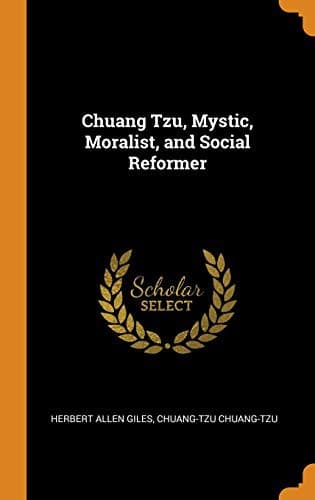
Chuang Tzu: Mystic, Moralist, and Social ReformerZhuangzi
Religion
Chuang Tzu: Mystic, Moralist, and Social Reformer
Zhuangzi
Ethics -- China; Philosophy, Chinese
"The Four Seas,--are they not to the universe but like puddles in a
marsh? The Middle Kingdom,--is it not to the surrounding ocean like a
tare-seed in a granary? Of all the myriad created things, man is but
one. And of all those who inhabit the land, live on the fruit of the
earth, and move about in cart and boat, an individual man is but one.
Is not he, as compared with all creation, but as the tip of a hair upon
a horse's skin?
"The succession of the Five Rulers, the contentions of the Three Kings,
the griefs of the philanthropist, the labours of the administrator, are
but this and nothing more.
_Sc._ ambition.
Poh I refused the throne for fame's sake. Confucius discoursed to get
a reputation for learning. This over-estimation of self on their part,
was it not very much your own in reference to water?"
"Very well," replied the Spirit of the River, "am I then to regard the
universe as great and the tip of a hair as small?"
"Not at all," said the Spirit of the Ocean. "Dimensions are limitless;
time is endless. Conditions are not invariable; terms are not final.
Thus, the wise man looks into space, and does not regard the small as
too little, nor the great as too much; for he knows that there is no
limit to dimension. He looks back into the past, and does not grieve
over what is far off, nor rejoice over what is near; for he knows that
time is without end.
Space infinite has been illustrated by Locke by a centre from which
you can proceed for ever in all directions. Time infinite, by a point
in a line from which you can proceed backwards and forwards for ever.
He investigates fulness and decay, and does not rejoice if he succeeds,
nor lament if he fails; for he knows that conditions are not invariable.
Fulness and decay are the inevitable precursors of each other.
He who clearly apprehends the scheme of existence, does not rejoice
over life, nor repine at death; for he knows that terms are not final.
Life and death are but links in an endless chain.
"What man knows is not to be compared with what he does not know.
The span of his existence is not to be compared with the span of
his non-existence. With the small to strive to exhaust the great,
necessarily lands him in confusion, and he does not attain his object.
How then should one be able to say that the tip of a hair is the _ne
plus ultra_ of smallness, or that the universe is the _ne plus ultra_
of greatness?"
These predicates are abstract terms, which are not names of real
existences but of relations, states, or conditions of existences; not
things, but conditions of things.
"Dialecticians of the day," replied the Spirit of the River, "all
say that the infinitesimally small has no form, and that the
infinitesimally great is beyond all measurement. Is that so?"
"If we regard greatness as compared with that which is small," said
the Spirit of the Ocean, "there is no limit to it; and if we regard
smallness as compared with that which is great, it eludes our sight.
Public-domain text, read in full here on John Shaqi.
Reviews
Reviews
No reviews yet
Be the first to share your thoughts on this work.
Elsewhere in the archive
Join the Discussion
Join the discussion
Sign in to leave a comment or review.
Sign InorCreate an account