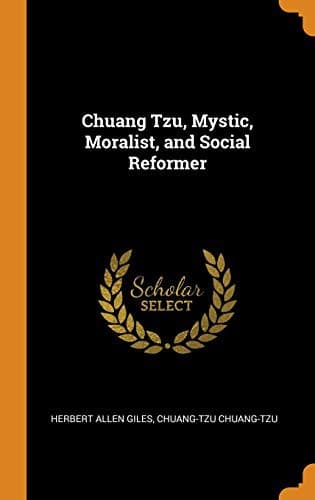
Chuang Tzu: Mystic, Moralist, and Social ReformerZhuangzi
Religion
Chuang Tzu: Mystic, Moralist, and Social Reformer
Zhuangzi
Ethics -- China; Philosophy, Chinese
From my own feelings above the bridge I infer those of the fishes
below.
CHAPTER XVIII.
PERFECT HAPPINESS.
_Argument_:--The uncertainty of human happiness--What the world aims
at is physical well-being--This is not profitable even to the body--In
inaction alone is true happiness to be found--Inaction the rule of
the material universe--Acquiescence in whatever our destiny may bring
forth--Illustrations.
[This chapter is supplementary to chapter vi.]
Is perfect happiness to be found on earth, or not? Are there those who
can enjoy life, or not? If so, what do they do, what do they affect,
what do they avoid, what do they rest in, accept, reject, like, and
dislike?
What the world esteems comprises wealth, rank, old age, and goodness
of heart. What it enjoys comprises comfort, rich food, fine clothes,
beauty, and music. What it does not esteem comprises poverty, want
of position, early death, and evil behaviour. What it does not enjoy
comprises lack of comfort for the body, lack of rich food for the
palate, lack of fine clothes for the back, lack of beauty for the
eye, and lack of music for the ear. If men do not get these, they are
greatly miserable. Yet from the point of view of our physical frame,
this is folly.
Physically we can, and most of us do, get along very well without
these extras.
Wealthy people who toil and moil, putting together more money than they
can possibly use,--from the point of view of our physical frame, is not
this going beyond the mark?
Officials of rank who turn night into day in their endeavours to
compass the best ends;--from the point of view of our physical frame,
is not this a divergence?
Man is born to sorrow, and what misery is theirs whose old age with
dulled faculties only means prolonged sorrow! From the point of view of
our physical frame, this is going far astray.
Patriots are in the world's opinion admittedly good. Yet their goodness
does not enable them to enjoy life;
Patriotism has been illustrated in China by countless heroic deeds,
associated always with the death of the hero concerned.
and so I know not whether theirs is veritable goodness or not. If the
former, it does not enable them to enjoy life; if the latter, it at any
rate enables them to cause others to enjoy theirs.
It has been said, "If your loyal counsels are not attended to, depart
quietly without resistance." Thus, when Tzŭ Hsü
The famous Wu Yüan, 6th century B.C., whose opposition to his
sovereign led to his own disgrace and death.
resisted, his physical frame perished; yet had he not resisted, he
would not have made his name. Is there then really such a thing as this
goodness, or not?
As to what the world does and the way in which people are happy now, I
know not whether such happiness be real happiness or not. The happiness
of ordinary persons seems to me to consist in slavishly following the
majority, as if they could not help it. Yet they all say they are happy.
Public-domain text, read in full here on John Shaqi.
Reviews
Reviews
No reviews yet
Be the first to share your thoughts on this work.
Elsewhere in the archive
Join the Discussion
Join the discussion
Sign in to leave a comment or review.
Sign InorCreate an account