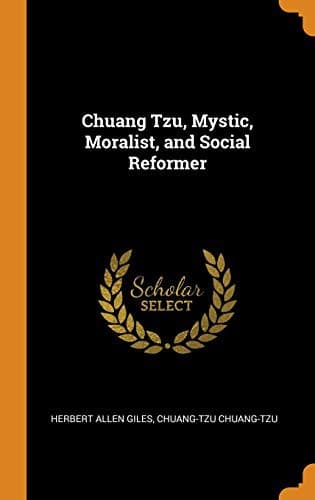
Chuang Tzu: Mystic, Moralist, and Social ReformerZhuangzi
Religion
Chuang Tzu: Mystic, Moralist, and Social Reformer
Zhuangzi
Ethics -- China; Philosophy, Chinese
"The general average of mankind are not only moderate in intellect,
but also in inclinations: they have no tastes or wishes strong enough
to incline them to do anything unusual." Mill's _Essay on Liberty_.
But I cannot say that this is happiness or that it is not happiness. Is
there then, after all, such a thing as happiness?
I make true pleasure to consist in _inaction_, which the world regards
as great pain. Thus it has been said, "Perfect happiness is the absence
of happiness;
The non-existence of any state or condition necessarily includes the
non-existence of its correlate. If we do not have happiness, we are
at once exempt from misery; and such a negative state is a state of
"perfect happiness."
perfect renown is the absence of renown."
Now in this sublunary world of ours it is impossible to assign positive
and negative absolutely. Nevertheless, in inaction they can be so
assigned. Perfect happiness and preservation of life are to be sought
for only in inaction.
Let us consider. Heaven does nothing; yet it is clear. Earth does
nothing; yet it enjoys repose. From the inaction of these two proceed
all the modifications of things. How vast, how infinite is inaction,
yet without source! How infinite, how vast, yet without form!
The endless varieties of things around us all spring from inaction.
Therefore it has been said, "Heaven and earth do nothing, yet there is
nothing which they do not accomplish." But among men, who can attain to
inaction?
Lin Hsi Chung condemns the whole of the above exordium as too closely
reasoned for Chuang Tzŭ, with his rugged, elliptical style.
When Chuang Tzŭ's wife died, Hui Tzŭ went to condole. He found the
widower sitting on the ground, singing, with his legs spread out at a
right angle, and beating time on a bowl.
"To live with your wife," exclaimed Hui Tzŭ, "and see your eldest son
grow up to be a man, and then not to shed a tear over her corpse,--this
would be bad enough. But to drum on a bowl, and sing; surely this is
going too far."
"Not at all," replied Chuang Tzŭ. "When she died, I could not help
being affected by her death. Soon, however, I remembered that she had
already existed in a previous state before birth, without form, or even
substance; that while in that unconditioned condition, substance was
added to spirit; that this substance then assumed form; and that the
next stage was birth. And now, by virtue of a further change, she is
dead, passing from one phase to another like the sequence of spring,
summer, autumn, and winter. And while she is thus lying asleep in
Eternity, for me to go about weeping and wailing would be to proclaim
myself ignorant of these natural laws. Therefore I refrain."
* * * * *
A hunchback and a one-legged man were looking at the tombs of departed
heroes, on the K'un-lun Mountains, where the Yellow Emperor rests.
Suddenly, ulcers broke out upon their left elbows, of a very loathsome
description.
Public-domain text, read in full here on John Shaqi.
Reviews
Reviews
No reviews yet
Be the first to share your thoughts on this work.
Elsewhere in the archive
Join the Discussion
Join the discussion
Sign in to leave a comment or review.
Sign InorCreate an account