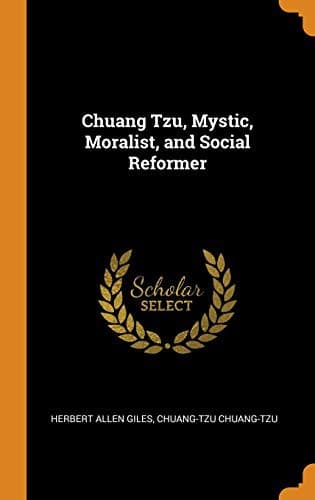
Chuang Tzu: Mystic, Moralist, and Social ReformerZhuangzi
Religion
Chuang Tzu: Mystic, Moralist, and Social Reformer
Zhuangzi
Ethics -- China; Philosophy, Chinese
Ch'ui the artisan could draw circles with his hand better than with
compasses. His fingers seemed to accommodate themselves so naturally
to the thing he was working at, that it was unnecessary to fix his
attention. His mental faculties thus remained ONE, and suffered no
hindrance.
To be unconscious of one's feet implies that the shoes are easy.
To be unconscious of a waist implies that the girdle is easy. The
intelligence being unconscious of positive and negative implies
that the heart is at ease. No modifications within, no yielding to
influences without,
But always following a natural course.
--this is ease under all conditions. And he who beginning with ease, is
never not at ease, is unconscious of the ease of ease.
Such is the condition of oblivion necessary to the due development of
our natural spontaneity.
* * * * *
A certain Sun Hsiu went to the house of Pien Ch'ing Tzŭ
Both unknown to fame.
and complained, saying, "In peace I am not considered wanting in
propriety. In times of trouble I am not considered wanting in courage.
Yet my crops fail; and officially I am not a success. From my village
an outcast, I am an outlaw from my State. How have I offended against
God that he should visit me with such a fate?"
"Have you not heard," replied Pien Tzŭ, "how the perfect man conducts
himself? He is oblivious of his physical organisation. He is beyond the
reach of sight and hearing. He moves outside the limits of this dusty
world, rambling transcendentally in the domain of no-affairs. This is
called acting but not from self-confidence, influencing but not from
authority.
That is, acting not in consequence of self-confidence, but without
reference to it; _sc._ naturally. Influencing, not because of
authority, but gaining authority because of natural influence.
This quotation appears, though Chuang Tzŭ or whoever may be
responsible for this episode does not say so, in chs. x. and li. of
the _Tao-Tê-Ching_.
"But you, you make a show of your knowledge in order to startle fools.
You cultivate yourself in contrast to the degradation of others. And
you blaze along as though the sun and moon were under your arms.
These last three sentences will be found verbatim in ch. xx.
Whereas, that you have a whole body in a whole skin, and have not
perished in mid career, dumb, blind, or halt, but actually hold a place
among men,--this ought to be enough for you. Why rail at God? Begone!"
Sun Hsiu went away, and Pien Tzŭ went in and sat down. Shortly
afterwards, he looked up to heaven and sighed; whereupon a disciple
asked him what was the matter.
"When Hsiu was here just now," answered Pien Tzŭ, "I spoke to him of
the virtue of the perfect man. I fear lest he be startled and so driven
on to doubt."
Public-domain text, read in full here on John Shaqi.
Reviews
Reviews
No reviews yet
Be the first to share your thoughts on this work.
Elsewhere in the archive
Join the Discussion
Join the discussion
Sign in to leave a comment or review.
Sign InorCreate an account