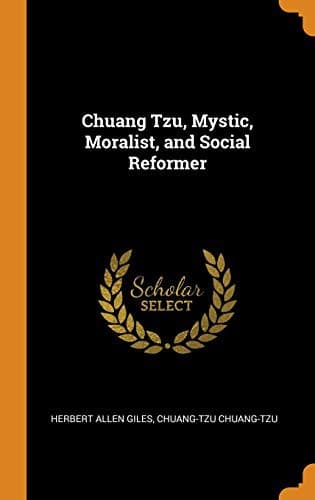
Chuang Tzu: Mystic, Moralist, and Social ReformerZhuangzi
Religion
Chuang Tzu: Mystic, Moralist, and Social Reformer
Zhuangzi
Ethics -- China; Philosophy, Chinese
This is what reason tells the philosopher. "All is ONE." The world is a
unity of opposing forces (παλίντροπος ἁρμονίη κόσμου ὅκωσπερ λύρας καὶ
τόξου).[33] "Join together whole and not whole, agreeing and different,
harmonious and discordant. Out of all comes one: out of one all."[34]
"God is day-night, winter-summer, war-peace, repletion-want."[35]
The very rhythm of nature is strife. War, which men hate and the
poets would banish, "is the father and lord of all."[36] But "men are
without understanding, they hear and hear not,"[37] or "they hear and
understand not."[38] For they trust to their senses, which are "false
witnesses."[39] They see the contradictions, but know not that "the
different is at unity with itself."[40] They cannot see the "hidden
harmony, which is greater than the harmony which is seen."[41] For
they live in the external, the commonplace, the relative, and never
rise above the life of the senses. "The sow loves the mire."[42]
"The ass prefers fodder to gold."[43] And men love their "private
conceits" instead of clinging to the universal reason which orders all
things,[44] and which even the sun obeys.[45]
[33] _Ibid._, xlv.
[34] _Ibid._, lix.
[35] _Ibid._, xxxvi.
[36] _Ibid._, xliv.
[37] _Ibid._, iii.
[38] _Ibid._, v.
[39] _Heracl. Eph. Rell._ iv.
[40] _Ibid._, xlv.
[41] _Ibid._, xlvii.
[42] _Ibid._, liv., and notes.
[43] _Ibid._, li.
[44] _Ibid._, xci, xix.
[45] _Ibid._, xxix.
Of the fragments which remain to us of Heracleitus, the greater number
belong to the region of logic and metaphysics, while Chuang Tzŭ devotes
much space to the more practical side of the question. He not only
ridicules those who trust their senses, or measure by utilitarian
standards, or judge by the outward appearance;--he teaches them how
to pass from the seeming to the true. The wonderful carver, who could
cut where the natural joints are,[46] is one who sees not with the
eye of sense but with his mind. When he is in doubt he "falls back
upon eternal principles"; for he is "devoted to TAO" (chap. iii).
There is something of humour, as well as much of truth, in the rebuke
which Confucius, speaking _pro hâc vice_ as a disciple of Lao Tzŭ,
administers to his self-confident follower who wanted to "be of use."
"Cultivate _fasting_;--not bodily fasting, but the fasting of the
heart." TAO can only abide in the life which has got rid of self.
So the Duke of Shê is reminded that there is something higher than
duty,[47] viz., _destiny_, the state, that is, in which conscious
obedience has given way to that which is instinctive and automatic. The
parable of the trees (pp. 50-53), with its result in the survival of
the good-for-nothing, is again a reversal of popular outside judgments.
For as the first part of the chapter had taught the uselessness of
trying to be useful, so the last part teaches the usefulness of being
useless. And the same thought is carried on in the next chapter, which
Public-domain text, read in full here on John Shaqi.
Reviews
Reviews
No reviews yet
Be the first to share your thoughts on this work.
Join the Discussion
Join the discussion
Sign in to leave a comment or review.
Sign InorCreate an account