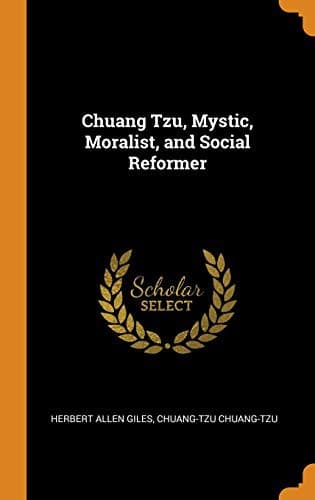
Chuang Tzu: Mystic, Moralist, and Social ReformerZhuangzi
Religion
Chuang Tzu: Mystic, Moralist, and Social Reformer
Zhuangzi
Ethics -- China; Philosophy, Chinese
"But put it in a bramble bush, and it will move cautiously with
sidelong glances, trembling all over with fear. Not that its muscles
relax in the face of difficulty, but because it is at a disadvantage
as regards position, and is unable to make use of its skill. And how
should any one, living under foolish sovereigns and wicked ministers,
help being miserable, even though he might wish not to be so?
"It was under such circumstances that Pi Kan was disembowelled."
See ch. iv. The above episode is too much even for Chinese critics,
and has been condemned accordingly.
* * * * *
When Confucius was hemmed in between Ch'ên and Ts'ai and had gone seven
days without food, then, holding in his left hand a piece of dry wood
and in his right hand a dry stick, he sang a ballad of Piao Shih.
An ancient ruler.
He had an instrument, but the gamut was wanting. There was sound, but
no tune. The sound of the wood accompanied by the voice of the man
yielded a harsh result, but it was in keeping with the feelings of his
audience.
Yen Hui, who was standing by in a respectful attitude, thereupon began
to turn his eyes about him; and Confucius, fearing lest he should be
driven by exaltation into bragging, or by a desire for safety into
sorrow,
As a result of hearing the song.
spoke to him as follows:--
"Hui! it is easy to escape injury from God; it is difficult to avoid
the benefits of man. There is no beginning and there is no end. Man and
God are ONE. Who then was singing just now?"
"Pray, Sir, what do you mean," asked Yen Hui, "by saying that it is
easy to escape injury from God?"
"Hunger, thirst, cold, and heat," replied Confucius, "are but as
fetters in the path of life. They belong to the natural laws which
govern the universe; and in obedience thereto I pass on my allotted
course. The subject dares not disregard the mandates of his prince. And
if this is man's duty to man, how much more shall it be his duty to
God?"
"What is the meaning of difficult to avoid the benefits of man?" asked
Yen Hui.
"If one begins," replied Confucius, "by adaptation to surroundings,
rank and power follow without cease. Such advantages are external; they
are not derived from oneself. And my life is more or less dependent
upon the external. The superior man does not steal these; nor does the
good man pilfer them. What then do I but take them as they come?
"Therefore it has been said that no bird is so wise as the swallow. If
it sees a place unfit to dwell in, it will not bestow a glance thereon;
and even though it should drop food there, it will leave the food and
fly away. Now swallows fear man. Yet they dwell among men. Because
there they find their natural abode."
In the same way, man should adapt himself to the conditions which
surround him.
"And what is the meaning," enquired Yen Hui, "of no beginning and no
end?"
Public-domain text, read in full here on John Shaqi.
Reviews
Reviews
No reviews yet
Be the first to share your thoughts on this work.
Elsewhere in the archive
Join the Discussion
Join the discussion
Sign in to leave a comment or review.
Sign InorCreate an account