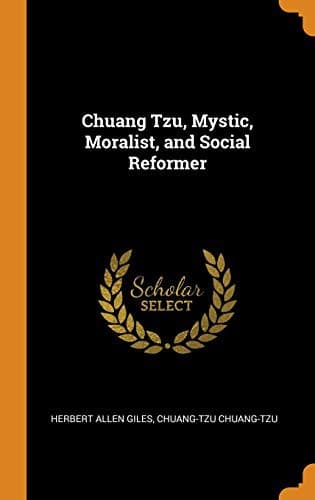
Chuang Tzu: Mystic, Moralist, and Social ReformerZhuangzi
Religion
Chuang Tzu: Mystic, Moralist, and Social Reformer
Zhuangzi
Ethics -- China; Philosophy, Chinese
"The work goes on," replied Confucius, "and no man knoweth the cause.
How then shall he know the end, or the beginning? There is nothing left
to us but to wait."
"And that man and God are ONE," said Yen Hui. "What does that mean?"
"That man is," replied Confucius, "is from God. That God is, is also
from God. That man is not God, is his nature.
_Sc._ that which makes him man.
The Sage quietly waits for death as the end."
Which shall unite him once again with God.
When Chuang Tzŭ was wandering in the park at Tiao-ling, he saw a
strange bird which came from the south. Its wings were seven feet
across. Its eyes were an inch in circumference. And it flew close past
Chuang Tzŭ's head to alight in a chestnut grove.
"What manner of bird is this?" cried Chuang Tzŭ. "With strong wings it
does not fly away. With large eyes it does not see."
Or it would not have flown so near.
So he picked up his skirts and strode towards it with his cross-bow,
anxious to get a shot. Just then he saw a cicada enjoying itself in the
shade, forgetful of all else. And he saw a mantis spring and seize it,
forgetting in the act its own body, which the strange bird immediately
pounced upon and made its prey. And this it was which had caused the
bird to forget its own nature.
And approach so close to man.
* * * * *
This episode has been widely popularised in Chinese every-day life.
Its details have been expressed pictorially in a roughly-executed
woodcut, with the addition of a tiger about to spring upon the man,
and a well into which both will eventually tumble. A legend at the
side reads,--"All is Destiny!"
"Alas!" cried Chuang Tzŭ with a sigh, "how creatures injure one
another. Loss follows the pursuit of gain."
Those who would prey on others are preyed upon in turn themselves.
So he laid aside his bow and went home, driven away by the park-keeper
who wanted to know what business he had there.
For three months after this, Chuang Tzŭ did not leave the house; and at
length Lin Chü
A disciple.
asked him, saying, "Master, how is it that you have not been out for so
long?"
"While keeping my physical frame," replied Chuang Tzŭ, "I lost sight of
my real self. Gazing at muddy water, I lost sight of the clear abyss.
Besides, I have learnt from the Master as follows:--"When you go into
the world, follow its customs."
This saying is attributed, in uncanonical works, to Confucius. But if
any one was "Master" to Chuang Tzŭ, it would of course be Lao Tzŭ.
Now when I strolled into the park at Tiao-ling, I forgot my real self.
That strange bird which flew close past me to the chestnut grove,
forgot its nature. The keeper of the chestnut grove took me for a
thief. Consequently I have not been out."
* * * * *
When Yang Tzŭ
Yang Chu. See ch. viii.
went to the Sung State, he passed a night at an inn.
Public-domain text, read in full here on John Shaqi.
Reviews
Reviews
No reviews yet
Be the first to share your thoughts on this work.
Elsewhere in the archive
Join the Discussion
Join the discussion
Sign in to leave a comment or review.
Sign InorCreate an account