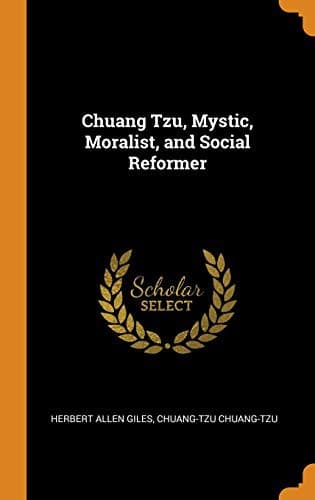
Chuang Tzu: Mystic, Moralist, and Social ReformerZhuangzi
Religion
Chuang Tzu: Mystic, Moralist, and Social Reformer
Zhuangzi
Ethics -- China; Philosophy, Chinese
and visit the wilds of Hsiang-ch'êng. My sight is now much better, and
I continue to dwell without the points of the compass. I should govern
the empire in just the same way. What else should I do?"
"Of course," said the Yellow Emperor, "government is not your trade.
Still I should be glad to hear what you would do."
The boy declined to answer, but on being again urged, cried out, "What
difference is there between governing the empire and looking after
horses? See that no harm comes to the horses, that is all!"
Thereupon the Emperor prostrated himself before the boy; and addressing
him as Divine Teacher, took his leave.
Divine Teacher means "inspired by God." The term used is that employed
in modern times for the head or Pope of debased Taoism, often wrongly
rendered as the "Master of Heaven."
* * * * *
If schemers have nothing to give them anxiety, they are not happy. If
dialecticians have not their premisses and conclusion, they are not
happy. If critics have none on whom to vent their spleen, they are not
happy. Such men are the slaves of objective existences.
Those who attract the sympathies of the world, start new dynasties.
Those who win the people's hearts, take high official rank. Those
who are strong undertake difficulties. Those who are brave encounter
dangers. Men of arms delight in war. Men of peace think of nothing but
reputation. Men of law strive to improve the administration. Professors
of ceremony and music cultivate deportment. Moralists devote themselves
to the obligations between man and man.
Take away agriculture from the husbandman, and his classification is
gone. Take away trade from the merchant, and his classification is
gone. Daily work is the stimulus of the labourer. The skill of the
artisan is his pride. If money cannot be made, the avaricious man
is sad. If his power meets with a check, the boaster will repine.
Ambitious men love change.
Thus, men are always doing something; inaction is to them impossible.
They observe in this the same regularity as the seasons, ever without
change. They hurry to destruction, dissipating in all directions their
vital forces, alas! never to return.
* * * * *
Chuang Tzŭ said, "If archers who aimed at nothing and hit something
were accounted good shots, everybody in the world would be another Yi.
See p. 308.
Could this be so?"
"It could," replied Hui Tzŭ.
"If there was no general standard of right in the world," continued
Chuang Tzŭ, "but each man had his own, then everybody would be a Yao.
Could this be so?"
"It could," replied Hui Tzŭ.
"Very well," said Chuang Tzŭ. "Now there are the Confucianists, the
Mihists, the schools of Yang
Yang Chu. See ch. viii.
and Ping,
Kung Sun Lung. See ch. xvii.
making with your own five in all. Pray which of these is right?
"Possibly it is a similar case to that of Lu Chü?
Of whom there is no record.
Public-domain text, read in full here on John Shaqi.
Reviews
Reviews
No reviews yet
Be the first to share your thoughts on this work.
Elsewhere in the archive
Join the Discussion
Join the discussion
Sign in to leave a comment or review.
Sign InorCreate an account