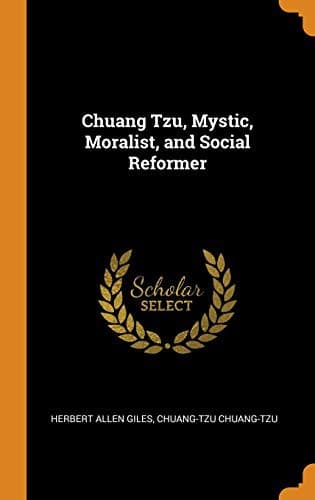
Chuang Tzu: Mystic, Moralist, and Social ReformerZhuangzi
Religion
Chuang Tzu: Mystic, Moralist, and Social Reformer
Zhuangzi
Ethics -- China; Philosophy, Chinese
"I have long desired to see you," answered the Prince. "I wish to love
my people, and by cultivation of duty towards one's neighbour to put an
end to war. Can this be done?"
"It cannot," replied Hsü Wu Kuei. "Love for the people is the root of
all evil to the people. Cultivation of duty towards one's neighbour
in order to put an end to war is the origin of all fighting. If your
Highness starts from this basis, the result can only be disastrous.
Why try to "do" anything?
"Everything that is made good, turns out bad.
The artificial is impermanent.
And although your Highness should make charity and duty to one's
neighbour, I fear they would be spurious articles. For the inward
intention would appear in the outward manifestation. The adoption of a
fixed standard
_I.e._ of the personal standard of individuals. See pp. 305, 306.
would lead to complications. And revolutions within lead to fighting
without. Surely your Highness would not make a bower into a
battlefield, nor a shrine of prayer into a scene of warfare!
This, of course, refers to the mind.
"Have nothing within which is obstructive of virtue. Seek not to
vanquish others in cunning, in plotting, in war. If I slay a whole
nation and annex the territory in order to find nourishment for my
passions and for my soul,--irrespective of military skill, wherein does
the victory lie?
"What shall it profit a man, if he shall gain the whole world, and
lose his own soul?"
"If your Highness will only abstain, that will be enough. Cultivate
the sincerity that is within your breast, so as to be responsive to the
conditions of your environment, and be not aggressive. The people will
thus escape death;
From oppression.
and what need then to put an end to war?"
* * * * *
When the Yellow Emperor went to see TAO upon the Chü-tz'ŭ Mountain,
Fang Ming was his charioteer, Ch'ang Yü sat on his right, Chang Jo and
Hsi P'êng were his outriders, and K'un Hun and Hua Chi brought up the
rear.
Commentators tear this passage to tatters.
On reaching the wilds of Hsiang-ch'êng,
The limit of the known.
these seven Sages lost their way and there was no one of whom to ask
the road. By and by, they fell in with a boy who was grazing horses,
and asked him, saying, "Do you know the Chü-tz'ŭ Mountain?"
"I do," replied the boy.
"And can you tell us," continued the Sages, "where TAO abides?"
"I can," replied the boy.
"This is a strange lad," cried the Yellow Emperor. "Not only does he
know where the Chü-tz'ŭ Mountain is, but also where TAO abides! Come
tell me, pray, how would you govern the empire?"
"I should govern the empire," said the boy, "just the same as I look
after my horses. What else should I do?
"When I was a little boy and used to live within the points of the
compass,
In Vanity Fair.
my eyes got dim of sight. An old man advised me to mount the chariot of
the sun
_I.e._ of Intelligence.
Public-domain text, read in full here on John Shaqi.
Reviews
Reviews
No reviews yet
Be the first to share your thoughts on this work.
Elsewhere in the archive
Join the Discussion
Join the discussion
Sign in to leave a comment or review.
Sign InorCreate an account