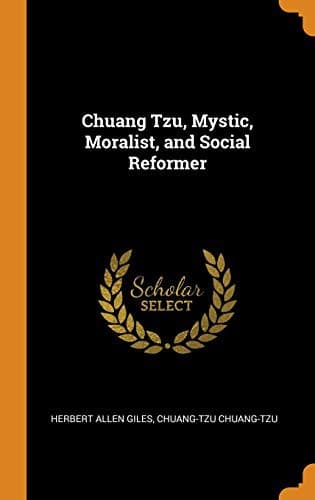
Chuang Tzu: Mystic, Moralist, and Social ReformerZhuangzi
Religion
Chuang Tzu: Mystic, Moralist, and Social Reformer
Zhuangzi
Ethics -- China; Philosophy, Chinese
"Life has its distinctions; but in death we are all made equal. That
death should have an origin, but that life should have no origin,--can
this be so? What determines its presence in one place, its absence in
another?
"Heaven has its fixed order.
Visible to all.
Earth has yielded up its secrets to man. But where to seek whence am I?
"Not knowing the hereafter, how can we deny the operation of Destiny?
Not knowing what preceded birth, how can we assert the operation of
Destiny? When things turn out as they ought, who shall say that the
agency is not supernatural? When things turn out otherwise, who shall
say that it is?"
* * * * *
The various Penumbræ said to the Umbra, "Before you were looking down,
now you are looking up. Before you had your hair tied up, now it is all
loosed. Before you were sitting, now you have got up. Before you were
moving, now you are stopping still. How is this?"
"Gentlemen," replied the Umbra, "the question is hardly worth asking.
Ultimate causes being unknowable.
I do these things, but I do not know why. I am like the scaly back of
the cicada, the shell of the locust,--apparently independent, but not
really so. By firelight or in daylight I am seen: in darkness or by
night I am gone. And if I am dependent on these, how much more are they
dependent on something else? When they come, I come with them. When
they go, I go with them. When they live, I live with them. But who it
is that gives the life, how shall we seek to know?"
Repeated, with variations, from ch. ii.
* * * * *
Yang Tzŭ Chü
See p. 100.
went southwards to P'ei, and when Lao Tzŭ was travelling westwards
to Ch'in, hastened to receive him outside the city. Arriving at the
bridge, he met Lao Tzŭ; and the latter standing in the middle of the
road, looked up to heaven and said with a sigh, "At first, I thought
you could be taught. I think so no more."
Yang Tzŭ Chü made no reply, but when they reached the inn, handed
Lao Tzŭ water for washing and rinsing, and a towel and comb. He then
removed his own boots outside the door, and crawling on his knees
into the Master's presence, said, "I have been wishing to ask for
instruction, Sir, but as you were travelling and not at leisure, I did
not venture. You are now, Sir, at leisure. May I enquire the reason of
what you said?"
"You have an overbearing look," said Lao Tzŭ. "Who would live with such
a man? He who is truly pure behaves as though he were sullied. He who
has virtue in abundance behaves as though it were not enough."
These last two sentences occur in the _Tao-Tê-Ching_, ch. xli, and
also in the works of Lieh Tzŭ as part of that author's own text. See
_The Remains of Lao Tzŭ_, p. 29.
Yang Tzŭ Chü changed countenance at this, and replied, "I hear and
obey."
Public-domain text, read in full here on John Shaqi.
Reviews
Reviews
No reviews yet
Be the first to share your thoughts on this work.
Elsewhere in the archive
Join the Discussion
Join the discussion
Sign in to leave a comment or review.
Sign InorCreate an account