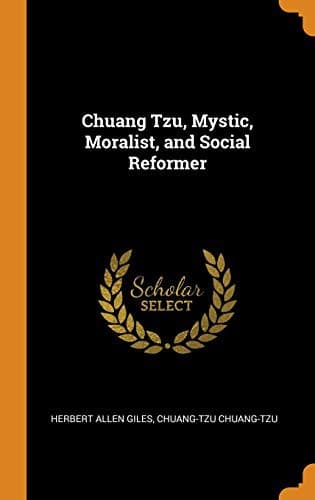
Chuang Tzu: Mystic, Moralist, and Social ReformerZhuangzi
Religion
Chuang Tzu: Mystic, Moralist, and Social Reformer
Zhuangzi
Ethics -- China; Philosophy, Chinese
"Very good," said Tzŭ Hua Tzŭ. "It is clear therefore that one's two
arms are worth more than the empire. And one's body is worth more than
one's arms, while the State of Han is infinitely less important than
the empire. Further, what you are struggling over is of infinitely less
importance than the State of Han. Yet your Highness is wearing out body
and soul alike in fear and anxiety lest you should not get it."
"Good indeed!" cried the prince. "Many have counselled me, but I have
never heard the like of this."
From which we may infer that Tzŭ Hua Tzŭ knew the difference between
what was of importance and what was not.
* * * * *
The prince of Lu, hearing that Yen Ho had attained to TAO, despatched
messengers with presents to open communications.
Yen Ho lived in a hovel. He wore clothes of coarse grass, and occupied
himself in tending oxen.
When the messengers arrived, Yen Ho went out to meet them; whereupon
they enquired, "Is this where Yen Ho lives?"
"This is Yen Ho's house," replied the latter.
The messengers then produced the presents; but Yen Ho said, "I fear you
have made a mistake. And as you might get into trouble, it would be as
well to go back and make sure."
This the messengers accordingly did. When however they returned, there
was no trace to be found of Yen Ho. Thus it is that men like Yen Ho
hate wealth and power.
Wherefore it has been said that the best part of TAO is for
self-culture, the surplus for governing a State, and the dregs for
governing the empire. From which we may infer that the great deeds of
kings and princes are but the leavings of the Sage. For preserving the
body and nourishing vitality, they are of no avail. Yet the superior
men of to-day endanger their bodies and throw away their lives in their
greed for the things of this world. Is not this pitiable?
The true Sage in all his actions considers the why and the wherefore.
But there are those now-a-days who use the pearl of the prince of Sui
to shoot a bird a thousand yards off.
A wonderfully brilliant gem, of a "ten chariot" illuminating power.
And the world of course laughs at them. Why? Because they sacrifice the
greater to get the less. But surely life is of more importance even
than the prince's pearl!
* * * * *
Lieh Tzŭ was poor. His face wore a hungry look.
A visitor one day mentioned this to Tzŭ Yang
Prime Minister.
of Chêng, saying, "Lieh Tzŭ is a scholar who has attained to TAO. He
lives in your Excellency's State, and yet he is poor. Can it be said
that your Excellency does not love scholars?"
Thereupon Tzŭ Yang gave orders that Lieh Tzŭ should be supplied with
food. But when Lieh Tzŭ saw the messengers, he bowed twice and declined.
Public-domain text, read in full here on John Shaqi.
Reviews
Reviews
No reviews yet
Be the first to share your thoughts on this work.
Elsewhere in the archive
Join the Discussion
Join the discussion
Sign in to leave a comment or review.
Sign InorCreate an account