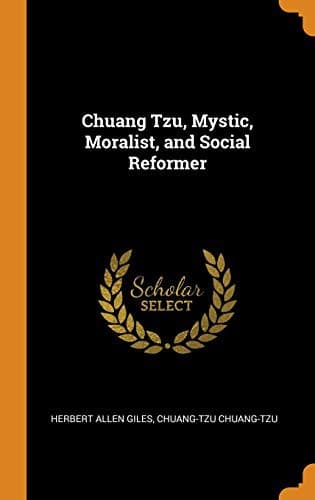
Chuang Tzu: Mystic, Moralist, and Social ReformerZhuangzi
Religion
Chuang Tzu: Mystic, Moralist, and Social Reformer
Zhuangzi
Ethics -- China; Philosophy, Chinese
When the messengers had gone, and Lieh Tzŭ went within, his wife gazed
at him, and beating her breast said, "I have heard that the wife and
children of a man of TAO are happy and joyful. But see how hungry I am.
His Excellency sent you food, and you would not take it. Is not this
flying in the face of Providence?"
"His Excellency did not know me personally," answered Lieh Tzŭ with a
smile. "It was because of what others said about me that he sent me the
food. If then men were to speak ill of me, he would also act upon it.
For that reason I refused the food."
Subsequently, there was trouble among the people of Chêng, and Tzŭ Yang
was slain.
* * * * *
When Prince Chao of the Ch'u State lost his kingdom, he was followed
into exile by his butcher, named Yüeh.
On his restoration, as he was distributing rewards to those who had
remained faithful to him, he came to the name of Yüeh.
Yüeh, however, said, "When the prince lost his kingdom, I lost my
butchery. Now that the prince has got back his kingdom, I have got
back my butchery. I have recovered my office and salary. What need for
further reward?"
On hearing this, the prince gave orders that he should be made to take
his reward.
"It was not through my fault," argued Yüeh, "that the prince lost
his kingdom, and I should not have taken the punishment. Neither was
it through me that he got it back, and I cannot therefore accept the
reward."
When the prince heard this answer, he commanded Yüeh to be brought
before him. But Yüeh said, "The laws of the Ch'u State require that a
subject shall have deserved exceptionally well of his prince before
being admitted to an audience. Now my wisdom was insufficient to
preserve this kingdom, and my courage insufficient to destroy the
invaders. When the Wu soldiers entered Ying, I feared for my life and
fled. That was why I followed the prince. And if now the prince wishes
to set law and custom aside and summon me to an audience, this is not
my idea of proper behaviour on the part of the prince."
"Yüeh," said the prince to Tzŭ Chi, his master of the horse, "occupies
a lowly position; yet his principles are of the most lofty. Go, make
him a San Ching."
"I am aware," replied Yüeh to the master of the horse, "that the post
of San Ching is more honourable than that of butcher. And I am aware
that the emolument is larger than what I now receive. Still, because I
want preferment and salary, I cannot let my prince earn the reputation
of being injudicious in his patronage. I must beg to decline. Let me go
back to my butchery."
And he adhered to his refusal.
Yüan Hsien dwelt in Lu,--in a mud hut, with a grass-grown roof, an
apology for a door, and two mulberry-trees for door-posts. The windows
which lighted his two rooms were no bigger than the mouth of a jar, and
were closed by a wad of old clothes. The hut leaked from above and was
damp under foot; yet Yüan Hsien sat gravely there playing on the guitar.
Public-domain text, read in full here on John Shaqi.
Reviews
Reviews
No reviews yet
Be the first to share your thoughts on this work.
Elsewhere in the archive
Join the Discussion
Join the discussion
Sign in to leave a comment or review.
Sign InorCreate an account