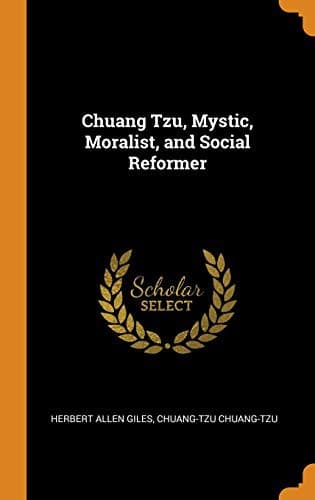
Chuang Tzu: Mystic, Moralist, and Social ReformerZhuangzi
Religion
Chuang Tzu: Mystic, Moralist, and Social Reformer
Zhuangzi
Ethics -- China; Philosophy, Chinese
"Besides, the pleasures of music, beauty, rich food, and power, do not
require to be studied before they can be appreciated by the mind; nor
does the body need the example of others before it can enjoy them. We
need no teacher to tell us what to like or dislike, to follow or to
avoid. Such knowledge is instinctive in man. The world may condemn this
view, but which of us is free from the taint?"
"The wise man," answered Complacency, "acts for the common weal, in
pursuit of which he does not overstep due limits. Wherefore, if there
is a sufficiency, he does not strive for more. He has no use for more,
and accordingly does not seek it. But if there is not a sufficiency,
then he seeks for more. He strives in all directions, yet does not
account it greed. If there is a surplus, he declines it. Even though
he refused the whole empire, he would not account it honesty. To him,
honesty and greed are not conditions into which we are forced by
outward circumstances, but characteristics innate in the individual.
He may wield the power of the Son of Heaven, but will not employ it
for the degradation of others. He may own the whole empire, yet will
not use his wealth to take advantage of his fellows. But a calculation
of the troubles and the anxieties inseparable therefrom, cause him
to reject these as injurious to his nature, not from a desire for
reputation.
"When Yao and Shun occupied the throne, there was peace. They did not
try to be beneficent rulers. They did not inflict injury by doing good.
They were simply natural, and good results followed.
"Shan Chüan and Hsü Yu both declined the proffered throne. Theirs was
no empty refusal. They would not cause injury to themselves.
"In all these cases, each individual adopted the profitable course in
preference to the injurious course. And the world calls them virtuous,
whereby they acquire a reputation at which they never aimed."
"It is necessary," argued Discontent, "to cling to reputation. If
all pleasures are to be denied to the body and one's energies to be
concentrated upon health with a view to the prolongation of life, such
life would be itself nothing more than the prolonged illness of a
confirmed invalid."
"Happiness," said Complacency, "is to be found in contentment. Too much
is always a curse, most of all in wealth.
"The ears of the wealthy man ring with sounds of sweet music. His
palate is cloyed with rich meats and wine. In the pursuit of pleasure,
business is forgotten. This is confusion.
"He eats and drinks to excess, until his breathing is that of one
carrying a heavy load up a hill. This is misery.
"He covets money to surround himself with comforts. He covets power
to vanquish rivals. But his quiet hours are darkened by diabetes and
dropsy. This is disease.
"Even when, in his desire for wealth, he has piled up an enormous
fortune, he still goes on and cannot desist. This is shame.
Public-domain text, read in full here on John Shaqi.
Reviews
Reviews
No reviews yet
Be the first to share your thoughts on this work.
Elsewhere in the archive
Join the Discussion
Join the discussion
Sign in to leave a comment or review.
Sign InorCreate an account