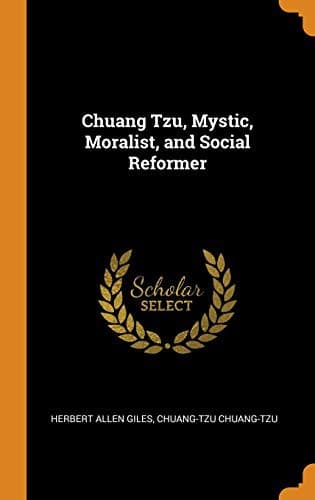
Chuang Tzu: Mystic, Moralist, and Social ReformerZhuangzi
Religion
Chuang Tzu: Mystic, Moralist, and Social Reformer
Zhuangzi
Ethics -- China; Philosophy, Chinese
"Not," says Lin Hsi Chung, "from the pen of Chuang Tzŭ."
* * * * *
Duke Ai of Lu asked Yen Ho, saying, "Were I to make Confucius a pillar
of my realm, would the State be profited thereby?"
"It would be most perilous!" replied Yen Ho. "Confucius is a man of
outward show and of specious words. He mistakes the branch for the root.
Accessories for fundamentals.
He seeks to impress the people by an overbearing demeanour, the
hollowness of which he does not perceive. If he suits you, and you
entrust him with the welfare of the State, it will only be by mistake
that he will succeed.
This passage is variously interpreted.
"To cause the people to leave the true and study the false does not
so much affect the people of to-day as those of coming generations.
Wherefore it is better not to have Confucius.
"The difficulty of governing lies in the inability to practise
self-effacement. Man does not govern as God does.
Regardless of self.
"Merchants and traders are altogether out of the pale.
Of TAO.
Or if chance ever brings them within it, their rights are never freely
admitted.
"External punishments are inflicted by metal and wood. Internal
punishments are inflicted by anxiety and remorse. Fools who incur
external punishment are treated with metal or wood. Those who incur
internal punishment are devoured by the conflict of emotions. It is
only the pure and perfect man who can succeed in avoiding both."
* * * * *
Confucius said, "The heart of man is more dangerous than mountains and
rivers, more difficult to understand than Heaven itself. Heaven has its
periods of spring, summer, autumn, winter, daytime and night. Man has
an impenetrable exterior, and his motives are inscrutable. Thus some
men appear to be retiring when they are really forward. Others have
abilities, yet appear to be worthless. Others are compliant, yet gain
their ends. Others take a firm stand, yet yield the point. Others go
slow, yet advance quickly.
"Those who fly to duty towards their neighbour as though thirsting
after it, drop it as though something hot. Thus the loyalty of
the superior man is tested by employing him at a distance, his
respectfulness by employing him near at hand. His ability, by
troublesome missions. His knowledge, by unexpected questions. His
trustworthiness, by specification of time limits. His integrity by
entrusting him with money. His fidelity, by dangerous tasks. His
decorum, by filling him with wine. His morality, by placing him in
disreputable surroundings. Under the application of these nine tests,
the inferior man stands revealed.
"Chêng K'ao Fu, on receiving his first appointment, bowed his head. On
receiving his second appointment, he hunched his back. On receiving his
third appointment, he fell upon his face, walking away at the side of
the path.
Instead of in the middle as any blustering braggart would have done.
Who would not try to be like him?
Public-domain text, read in full here on John Shaqi.
Reviews
Reviews
No reviews yet
Be the first to share your thoughts on this work.
Elsewhere in the archive
Join the Discussion
Join the discussion
Sign in to leave a comment or review.
Sign InorCreate an account