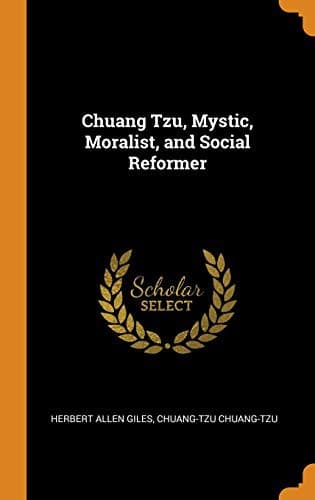
Chuang Tzu: Mystic, Moralist, and Social ReformerZhuangzi
Religion
Chuang Tzu: Mystic, Moralist, and Social Reformer
Zhuangzi
Ethics -- China; Philosophy, Chinese
"Take any worthless fellow who laughs at mankind for holding virtue
in esteem, any unprincipled vagabond who reviles the great Sages of
the world, and subject him to torture. In his agony he will sacrifice
positive and negative alike. If he can but get free, he will trouble no
more about knowledge and forethought. Past and future will cease to
exist for him, in his then neutral condition.
"Move when pushed, come when dragged. Be like a whirling gale, like a
feather in the wind, like a mill-stone going round. The mill-stone as
an existence is perfectly harmless. In motion or at rest it does no
more than is required, and cannot therefore incur blame.
"Why? Because it is simply an inanimate thing. It has no anxieties
about itself. It is never entangled in the trammels of knowledge. In
motion or at rest it is always governed by fixed laws, and therefore it
never becomes open to praise. Hence it has been said, 'Be as though an
inanimate thing, and there will be no use for Sages.'
"For a clod cannot be without TAO,"--at which some full-blooded young
buck covered the argument with ridicule by crying out, "Shên Tao's TAO
is not for the living, but for the dead!"
It was the same with T'ien P'ien. He studied under P'êng Mêng; with the
result that he learnt nothing.
TAO cannot be learnt.
P'êng Mêng's tutor said, "Those of old who knew TAO, reached the point
where positive and negative ceased to exist. That was all."
Now the bent of these men is one of opposition, which it is difficult
to discuss. They act in every way differently from other people, but
cannot escape the imputation of purpose.
Which takes the place of spontaneity.
What they call Tao is not TAO; and what they predicate affirmatively
cannot escape being negative. The fact is that P'êng Mêng, T'ien P'ien,
and Shên Tao, did not know TAO. Nevertheless they all had a certain
acquaintance with it.
To make the root the essential, to regard objective existences as
accidental, to look upon accumulation as deficiency, and to meekly
accept the dispositions of Providence,--herein lay the TAO of the
ancients.
Kuan Yin and Lao Tzŭ became enthusiastic followers of TAO.
For Kuan Yin, see p. 230.
They based their system upon nothingness, with ONE as their criterion.
Their outward expression was gentleness and humility. Their inward
belief was in unreality and avoidance of injury to all things.
Kuan Yin said, "Adopt no absolute position. Let externals take care of
themselves. In motion, be like water. At rest, like a mirror.
Receptive, but not permanently so.
Respond, like the echo.
Only when called upon.
Be subtle, as though non-existent. Be still, as though pure. Regard
uniformity as peace. Look on gain as loss. Do not precede others.
Follow them."
Lao Tzŭ said, "He who conscious of being strong, is content to be
weak,--he shall be a cynosure of men.
Public-domain text, read in full here on John Shaqi.
Reviews
Reviews
No reviews yet
Be the first to share your thoughts on this work.
Elsewhere in the archive
Join the Discussion
Join the discussion
Sign in to leave a comment or review.
Sign InorCreate an account