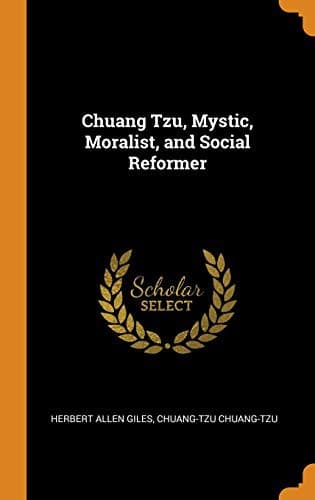
Chuang Tzu: Mystic, Moralist, and Social ReformerZhuangzi
Religion
Chuang Tzu: Mystic, Moralist, and Social Reformer
Zhuangzi
Ethics -- China; Philosophy, Chinese
This is quoted by Huai Nan Tzŭ as a saying by Lao Tzŭ, and appears in
ch. xxviii of the _Tao-Tê-Ching_. See _The Remains of Lao Tzŭ_, p. 21.
"He who conscious of purity, puts up with disgrace,--he shall be the
cynosure of mankind.
"He who when others strive to be first, contents himself with the
lowest place, is said to accept the contumely of the world.
"He who when others strive for the substantial, contents himself with
the unsubstantial, stores up nothing and therefore has abundance. There
he is in the midst of his abundance which comes to him without effort
on his part. He does nothing, and laughs at the artifices of others.
"He who when others strive for happiness is content with security, is
said to aim at avoiding evil.
Compare the _Tao-Tê-Ching_, ch. xxii.
"He who makes depth of fundamental importance and moderation his rule
of life, is said to crush that which is hard within him and temper that
which is sharp.
"To be in liberal sympathy with all creation, and not to be aggressive
towards one's fellow-men,--this may be called perfection."
O Kuan Yin! O Lao Tzŭ! verily ye were the true Sages of old.
Silence, formlessness, change, impermanence, now life, now death,
heaven and earth blended in one, the soul departing, gone no one knows
where: suddenly, no one knows whither, as all things go in turn, never
to come back again;--herein lay the TAO of the ancients.
Chuang Tzŭ became an enthusiastic follower of TAO. In strange terms,
in bold words, in far-reaching language, he gave free play to his
thoughts, without following any particular school or committing himself
to any particular line.
He looked on the world as so sunk in corruption that it was impossible
to speak gravely. Therefore he employed "goblet words" which apply in
various directions; he based his statements upon weighty authority in
order to inspire confidence; and he put words in other people's mouths
in order to secure breadth.
See ch. xxvii _ad init._
In accord with the spirit of the universe, he was at peace with all
creation. He judged not the rights and wrongs of mankind, and thus
lived quietly in his generation. Although his book is an extraordinary
production, it is plausible and harmless enough. Although the style is
most irregular, it is at the same time ingenious and attractive.
As a thinker, he is endlessly suggestive. Above, he roams with God.
Below, he consorts with those who are beyond the pale of life and
death, who deny a beginning and an end. In relation to the root,
The origin of all things.
he speaks on a grand and extensive scale. In relation to TAO, he
establishes a harmony between man and the higher powers. Nevertheless,
he yields to the modifications of existence and responds to the
exigencies of environment. His arguments are inexhaustible, and never
illogical. He is far-reaching, mysterious, and not to be fully explored.
Public-domain text, read in full here on John Shaqi.
Reviews
Reviews
No reviews yet
Be the first to share your thoughts on this work.
Elsewhere in the archive
Join the Discussion
Join the discussion
Sign in to leave a comment or review.
Sign InorCreate an account