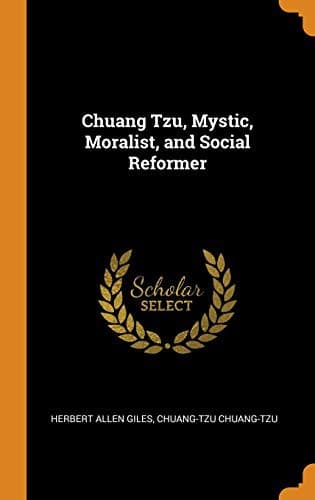
Chuang Tzu: Mystic, Moralist, and Social ReformerZhuangzi
Religion
Chuang Tzu: Mystic, Moralist, and Social Reformer
Zhuangzi
Ethics -- China; Philosophy, Chinese
That a white dog is black.
If his eyes are black. Part standing for the whole.
That a motherless colt never had a mother.
When it had a mother, it was not an orphan.
That if you take a stick a foot long and every day cut it in half, you
will never come to the end of it.
Compare "Achilles and the Tortoise," and the sophisms of the Greek
philosophers.
And such was the stuff which dialecticians used to argue about with Hui
Tzŭ, also without ever getting to the end of it.
Huan T'uan and Kung Sun Lung were of this class. By specious premisses
they imposed on people's minds and drove them into false conclusions.
But though they won the battle in words, they did not carry conviction
into their adversaries' hearts. Theirs were but the snares of the
sophist.
Hui Tzŭ daily devoted his intelligence to such pursuits, purposely
advancing some preposterous thesis upon which to dispute. That was his
characteristic. He had besides a great opinion of his own wisdom, and
used to say, "The universe does not hold my peer."
Hui Tzŭ makes a parade of his strength, but is devoid of any sound
system. An eccentric fellow in the south, named Huang Liao, asked why
the sky did not fall and the earth sink; also, whence came wind, rain,
and thunder.
Hui Tzŭ was not backward in replying to these questions, which he
answered unhesitatingly. He went into a long discussion on all
creation, and talked away without end, though to himself he seemed to
be saying very little. He supplemented this with most extraordinary
statements, making it his chief object to contradict others, and being
desirous of gaining fame by defeating all comers. Thus, he was never
popular. Morally, he was weak; physically, he was violent. His was a
dark and narrow way.
Looked at from the point of view of the TAO of the universe, the
value of Hui Tzŭ may be compared with the efforts of a mosquito or a
gadfly. Of what use was he to the world? As a specialist, he might have
succeeded. But to let him put himself forward as an exponent of TAO,
would have been dangerous indeed.
He would not however be content to be a specialist. He must needs roam
insatiably over all creation, though he only succeeded in securing the
reputation of a sophist.
Alas for the talents of Hui Tzŭ! He is extravagantly energetic, and yet
has no success. He investigates all creation, but does not conclude in
TAO. He makes a noise to drown an echo. He is like a man running a race
with his own shadow. Alas!
As to the genuineness of this concluding chapter, every one may form
his own opinion. The question has been hotly fought, and great names
could be mentioned on each side. Wang An Shih and Su Tung P'o both
thought that it might well have come from the hand of Chuang Tzŭ.
Lin Hsi Chung thought not, and on his side the majority of Western
students will in all probability be ranged.
_INDEX_
Accidentals, 162
Achilles and the Tortoise, 453
Action, 5, 266, 293
Affirmative and Negative, 17
Public-domain text, read in full here on John Shaqi.
Reviews
Reviews
No reviews yet
Be the first to share your thoughts on this work.
Elsewhere in the archive
Join the Discussion
Join the discussion
Sign in to leave a comment or review.
Sign InorCreate an account