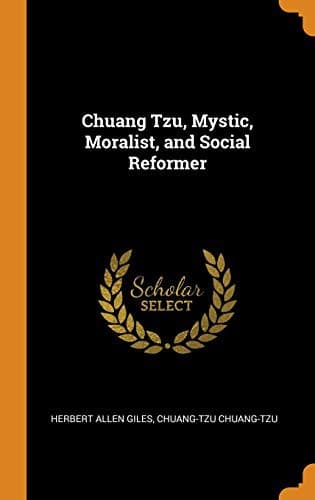
Chuang Tzu: Mystic, Moralist, and Social ReformerZhuangzi
Religion
Chuang Tzu: Mystic, Moralist, and Social Reformer
Zhuangzi
Ethics -- China; Philosophy, Chinese
It is impossible for a European critic to believe that Chuang Tzŭ
penned the above paragraphs. See _post_, p. 454.
Hui Tzŭ was a man of many ideas. His works would fill five carts. But
his doctrines are paradoxical, and his terms are used ambiguously.
He calls infinite greatness, beyond which there is nothing, the Greater
One. He calls infinite smallness, within which there is nothing, the
Lesser One.
Recognising two absolute extremes.
He says that that which is without dimensions measures a thousand _li_.
On the principle that mathematical points, though themselves without
dimensions, collectively fill up space.
That heaven and earth are equally low. That mountain and marsh are
equally level.
It depends upon the point of view.
That the sun at noon is the sun setting.
To people living farther east.
That when an animal is born, it dies.
As regards its previous state it dies when leaving it for a new state.
That the likeness of things partly unlike is called the lesser
likeness of unlikes. That the likeness of things altogether unlike is
called the greater likeness of unlikes. That southwards there is no
limit, and yet there is a limit. That one can reach Yüeh to-day and yet
be there before. That joined rings can be separated. That the middle of
the world is north of Yen and south of Yüeh.
It is wherever the speaker is. The space between Yen and Yüeh is as
zero compared with the infinite.
That he loves all creation equally, just as heaven and earth are
impartial to all.
In covering and supporting all.
Accordingly, Hui Tzŭ was regarded as a great philosopher and a
very subtle dialectician; and became a favourite with the other
dialecticians of the day.
He said that there were feathers in an egg.
Because on a chicken.
That a fowl had three feet.
The third being _volition_.
That Ying was the world.
As you cannot say it is not the world.
That a dog could be a sheep. That a mare could lay eggs. That a nail
has a tail.
Names being arbitrary in all cases.
That fire is not hot.
It is the man who feels it hot.
That mountains have mouths.
As evidenced by echoes.
That wheels do not press down the ground.
Touching only at a point.
That the eye does not see.
It is the man.
That the finger does not touch. That the uttermost extreme is not the
end. That a tortoise is longer than a snake.
Because longer lived!
That a carpenter's square is not square.
Like Horace's Whetstone which makes other things sharp, "exsors ipsa
secandi."
That compasses will not make a circle.
It is the draughtsman.
That a round hole will not surround a square handle. That the shadow
of a flying bird does not move. That there is a moment when a
swiftly-flying arrow is neither moving nor at rest. That a dog is not a
hound.
Two things cannot be identical unless even their names are the same.
That a bay horse and a dun cow are three.
Taken separately they are two. Taken together they are one. One and
two make three.
Public-domain text, read in full here on John Shaqi.
Reviews
Reviews
No reviews yet
Be the first to share your thoughts on this work.
Elsewhere in the archive
Join the Discussion
Join the discussion
Sign in to leave a comment or review.
Sign InorCreate an account