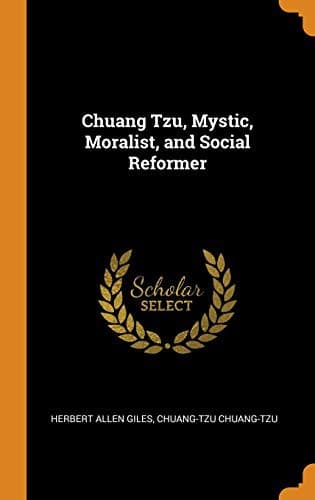
Chuang Tzu: Mystic, Moralist, and Social ReformerZhuangzi
Religion
Chuang Tzu: Mystic, Moralist, and Social Reformer
Zhuangzi
Ethics -- China; Philosophy, Chinese
"Take the human body with all its manifold divisions. Which part of
it does a man love best? Does he not cherish all equally, or has he a
preference? Do not all equally serve him? And do these servitors then
govern themselves, or are they subdivided into rulers and subjects?
Surely there is some soul which sways them all.
"But whether or not we ascertain what are the functions of this soul,
it matters but little to the soul itself. For coming into existence
with this mortal coil of mine, with the exhaustion of this mortal coil
its mandate will also be exhausted. To be harassed by the wear and
tear of life, and to pass rapidly through it without possibility of
arresting one's course,--is not this pitiful indeed? To labour without
ceasing, and then, without living to enjoy the fruit, worn out, to
depart, suddenly, one knows not whither,--is not that a just cause for
grief?
"What advantage is there in what men call not dying? The body
decomposes, and the mind goes with it. This is our real cause for
sorrow. Can the world be so dull as not to see this? Or is it I alone
who am dull, and others not so?
"If we are to be guided by the criteria of our own minds, who shall be
without a guide?
The mind should be a _tabula rasa_, free from all judgments or
opinions of its own as to the external world, and ready only to accept
things as they are, not as they appear to be.
What need to know of the alternations of passion,
As above described.
when the mind thus affords scope to itself?--verily even the minds of
fools! Whereas, for a mind without criteria
As it should be.
to admit the idea of contraries, is like saying, _I went to Yüeh
to-day, and got there yesterday_.
One of Hui Tzŭ's paradoxes. See ch. xxxiii.
Or, like placing nowhere somewhere,--topography which even the Great Yü
The famous engineer of antiquity (B.C. 2205), who drained the empire
of a vast body of water and arranged its subdivision into nine
provinces.
would fail to understand; how much more I?
"Speech is not mere breath. It is differentiated by meaning. Take away
that, and you cannot say whether it is speech or not. Can you even
distinguish it from the chirping of young birds?
"But how can TAO be so obscured that we speak of it as true and
false? And how can speech be so obscured that it admits the idea of
contraries? How can TAO go away and yet not remain?
Being omnipresent.
How can speech exist and yet be impossible?
See p. 13.
"TAO is obscured by our want of grasp. Speech is obscured by the gloss
of this world.
_I.e._ by the one-sided meanings attached to words and phrases.
Hence the affirmatives and negatives of the Confucian and Mihist
schools,
Mih Tzŭ was a philosopher of the fourth century B.C., who propounded
various theories which were vigorously attacked by the Confucianists
under Mencius. We shall hear more of him by-and-by.
Public-domain text, read in full here on John Shaqi.
Reviews
Reviews
No reviews yet
Be the first to share your thoughts on this work.
Join the Discussion
Join the discussion
Sign in to leave a comment or review.
Sign InorCreate an account