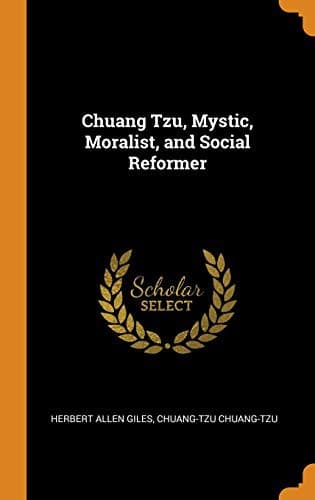
Chuang Tzu: Mystic, Moralist, and Social ReformerZhuangzi
Religion
Chuang Tzu: Mystic, Moralist, and Social Reformer
Zhuangzi
Ethics -- China; Philosophy, Chinese
The most famous of all the disciples of Confucius, admitted by the
latter to have been as near perfection as possible.
"How so?" asked the latter.
"I have got rid of charity and duty," replied the former.
"Very good," replied Confucius, "but not perfect."
Another day Yen Hui met Confucius and said, "I am getting on."
"How so?" asked Confucius.
"I have got rid of ceremonial and music," answered Yen Hui.
"Very good," said Confucius, "but not perfect."
On a third occasion Yen Hui met Confucius and said, "I am getting on."
"How so?" asked the Sage.
"I have got rid of everything," replied Yen Hui.
"Got rid of everything!" said Confucius eagerly. "What do you mean by
that?"
"I have freed myself from my body," answered Yen Hui. "I have discarded
my reasoning powers. And by thus getting rid of body and mind, I have
become ONE with the Infinite. This is what I mean by getting rid of
everything."
"If you have become ONE," cried Confucius, "there can be no room for
bias. If you have passed into space, you are indeed without beginning
or end. And if you have really attained to this, I trust to be allowed
to follow in your steps."
* * * * *
Tzŭ Yü and Tzŭ Sang were friends. Once when it had rained for ten days,
Tzŭ Yü said, "Tzŭ Sang is dangerously ill." So he packed up some food
and went to see him.
In accordance with the exigencies of mortality. How Tzŭ Yü knew that
his friend was ill is not clear. An attempt has been made by one
commentator on the basis of animal magnetism, in which the Chinese
have believed for centuries.
Arriving at the door, he heard something between singing and
lamentation, accompanied with the sound of music, as follows:--
"O father! O mother! O Heaven! O Man!"
These words seemed to be uttered with a great effort; whereupon Tzŭ Yü
went in and asked what it all meant.
"I was trying to think who could have brought me to this extreme,"
replied Tzŭ Sang, "but I could not guess. My father and mother would
hardly wish me to be poor. Heaven covers all equally. Earth supports
all equally. How can they make me in particular poor? I was seeking to
know who it was, but without success. Surely then I am brought to this
extreme by _Destiny_."
"The word Fate, or Destiny, expresses the sense of mankind in all
ages--that the laws of the world do not always befriend, but often
hurt and crush us."--_Emerson._
CHAPTER VII.
HOW TO GOVERN.
_Argument_:--Princes should reign, not rule--Rulers find their
standards of right in themselves--They thus coerce their people into
obeying artificial laws, instead of leaving them to obey natural
laws--By action they accomplish nothing--By inaction there is nothing
which they would not accomplish--Individuals think they know what
the empire wants--In reality it is the empire itself which know
best--Illustrations.
Yeh Ch'üeh asked Wang I
See ch. ii.
four questions, none of which he could answer. Thereat the former was
greatly delighted,
Public-domain text, read in full here on John Shaqi.
Reviews
Reviews
No reviews yet
Be the first to share your thoughts on this work.
Elsewhere in the archive
Join the Discussion
Join the discussion
Sign in to leave a comment or review.
Sign InorCreate an account