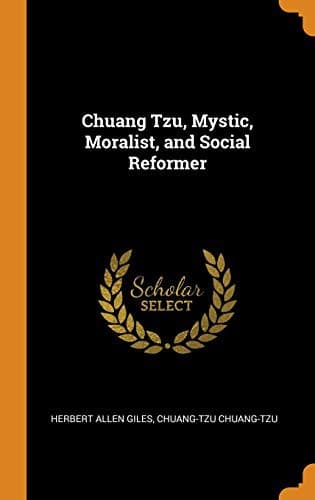
Chuang Tzu: Mystic, Moralist, and Social ReformerZhuangzi
Religion
Chuang Tzu: Mystic, Moralist, and Social Reformer
Zhuangzi
Ethics -- China; Philosophy, Chinese
For now he discovered that ignorance is true knowledge:--an
explanation which I adopt only for want of a better.
and went off and told P'u I Tzŭ.
Of whom nothing definite is known.
"Have you only just found that out?" said P'u I Tzŭ. "The Emperor Shun
was not equal to T'ai Huang.
A legendary ruler. For Shun, see ch. i.
Shun was all for charity in his zeal for mankind; but although he
succeeded in government, he himself never rose above the level of
artificiality. Now T'ai Huang was peaceful when asleep and inactive
when awake. At one time he would think himself a horse; at another, an
ox.
So effectually had he closed all channels leading to consciousness of
self.
His wisdom was substantial and above suspicion. His virtue was genuine
indeed. And yet he never sank to the level of artificiality."
He was a monarch after the pattern of TAO.
* * * * *
Chien Wu meeting the eccentric Chieh Yü, the latter enquired, saying,
"What did Jih Chung Shih teach you?"
Of the last nothing is known. The first two have been already
mentioned in chs. i. and vi.
"He taught me," replied Chien Wu, "about the laws and regulations which
princes evolve, and which he said none would venture not to hear and
obey."
"That is a false teaching indeed," replied Chieh Yü. "To attempt to
govern mankind thus,--as well try to wade through the sea, to hew a
passage through a river, or make a mosquito fly away with a mountain!
"The government of the truly wise man has no concern with externals.
He first perfects himself, and then by virtue thereof he is enabled to
accomplish what he wants.
Passively, without effort of any kind.
"The bird flies high to avoid snare and dart. The mouse burrows down
below the hill to avoid being smoked or cut out of its nest. Is your
wit below that of these two creatures?"
That you should be unable to devise means of avoiding the artificial
restraints of princes. Better than coercing into goodness is letting
men be good of their own accord.
T'ien Kên
Of whom nothing is known.
was travelling on the south of the Yin mountain. He had reached the
river Liao when he met a certain Sage to whom he said, "I beg to ask
about the government of the empire."
"Begone!" cried the Sage. "You are a low fellow, and your question is
ill timed. God has just turned me out a man. That is enough for me.
Borne on light pinions I can soar beyond the cardinal points, to the
land of nowhere, in the domain of nothingness. And you come to worry me
with government of the empire!"
But T'ien Kên enquired a second time, and the Sage replied, "Resolve
your mental energy into abstraction, your physical energy into
inaction. Allow yourself to fall in with the natural order of
phenomena, without admitting the element of self,--and the empire will
be governed."
By virtue of natural laws which lead, without man's interference, to
the end desired.
Public-domain text, read in full here on John Shaqi.
Reviews
Reviews
No reviews yet
Be the first to share your thoughts on this work.
Elsewhere in the archive
Join the Discussion
Join the discussion
Sign in to leave a comment or review.
Sign InorCreate an account