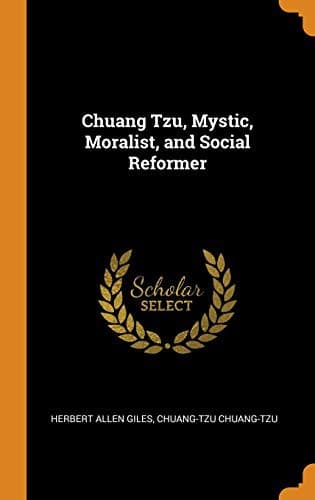
Chuang Tzu: Mystic, Moralist, and Social ReformerZhuangzi
Religion
Chuang Tzu: Mystic, Moralist, and Social Reformer
Zhuangzi
Ethics -- China; Philosophy, Chinese
The text, as it now stands, consists of thirty-three chapters. These
are a reduction from fifty-three, which appear to have been in
existence in the fourth century A.D.[14] The following is the account
given in the Imperial Catalogue of the first known edition:--
[14] On the authority of the _I-wên-chih_.
Chuang Tzŭ, with Commentary, in 10 books. By Kuo Hsiang of the Chin
dynasty (A.D. 265-420).
The _Shih-shuo-hsin-yü_[15] states that Kuo Hsiang stole his work from
Hsiang Hsiu.[16] Subsequently, Hsiang Hsiu's edition was issued, and
the two were in circulation together. Hsiang Hsiu's edition is now
lost, while Kuo Hsiang's remains.
[15] A work of the fifth century A.D.
[16] Of the Han dynasty. Mayers puts him a little later, viz., A.D.
275.
Comparison with quotations from Hsiang Hsiu's work, as given in
_Chuang Tzŭ Explained_, by Lu Tê-ming, shows conclusive evidence of
plagiarism. Nevertheless, Kuo Hsiang contributed a certain amount of
independent revision, making it impossible for us to regard the whole
as from the hand of Hsiang Hsiu. Consequently, it now passes under the
name of Kuo Hsiang.
Since Kuo Hsiang's time, numberless editions with ever-varying
interpretations have been produced to delight and to confuse the
student. Of these, I have chosen six, representative as nearly as
possible of different schools of thought. Their editors are:--
1.--KUO HSIANG of the Chin dynasty. (_a_) As given in the _Shih Tzŭ
Ch'üan Shu_, or Complete Works of the Ten Philosophers. (_b_) As
edited by Tan Yüan-ch'un, of the Ming dynasty, with his own valuable
notes.
2.--LÜ HUI-CH'ING of the Sung dynasty.
3.--LIN HSI-YI of the Sung dynasty.
4.--WANG YÜ of the Sung dynasty. Son of the famous Wang An-shih.
5.--HSING TUNG, a Taoist priest of the Ming dynasty.
6.--LIN HSI-CHUNG, of the Ming and Ch'ing dynasties.
Where there is a consensus of opinion, I have followed such
interpretation without demur. But where opinions differ, I have not
hesitated to accept that interpretation which seemed to me to be most
in harmony with the general tenor of Chuang Tzŭ's philosophy. And
where all commentators fail equally, as they sometimes do, to yield
anything at all intelligible, I have then ventured to fall back upon
what Chuang Tzŭ himself would have called the "light of nature." Always
keeping steadily in view the grand precept of Lin Hsi-chung, that we
should attempt to interpret Chuang Tzŭ neither according to Lao Tzŭ,
nor according to Confucius, nor according to Buddha, but according to
Chuang Tzŭ himself.
* * * * *
Of the thirty-three existing chapters, the first seven are called
"inside" chapters, the next fifteen "outside," and the remaining eleven
"miscellaneous."
Public-domain text, read in full here on John Shaqi.
Reviews
Reviews
No reviews yet
Be the first to share your thoughts on this work.
Join the Discussion
Join the discussion
Sign in to leave a comment or review.
Sign InorCreate an account