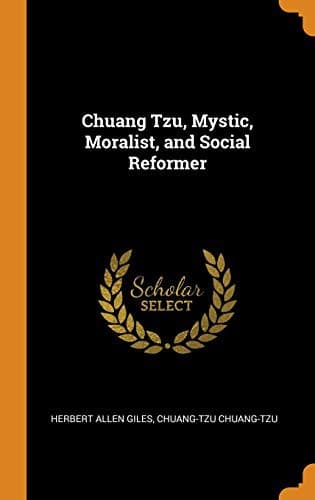
Chuang Tzu: Mystic, Moralist, and Social ReformerZhuangzi
Religion
Chuang Tzu: Mystic, Moralist, and Social Reformer
Zhuangzi
Ethics -- China; Philosophy, Chinese
And I venture to state that nothing of that which the world calls wit,
is otherwise than serviceable to strong thieves; and that nothing of
that which the world calls wisdom is other than a protection to strong
thieves.
How can this be shown?--In the State of Ch'i a man used to be able to
see from one town to the next, and hear the barking and crowing of its
dogs and cocks.
So near were they. This sentence has been incorporated in ch. LXXX of
the _Tao-Tê-Ching_. See _The Remains of Lao Tzŭ_, p. 50.
The area covered by the nets of fishermen and fowlers, and pricked by
the plough, was a square of two thousand and odd _li_.
Of which three go to a mile, roughly. This statement is intended to
convey an idea of prosperity.
And within its four boundaries not a temple or shrine was dedicated,
nor a district or hamlet governed, but in accordance with the rules
laid down by the Sages.
Yet one morning
B.C. 481.
T'ien Ch'êng Tzŭ slew the Prince of Ch'i, and stole his kingdom. And
not his kingdom only, but the wisdom-tricks which he had got from
the Sages as well; so that although T'ien Ch'êng Tzŭ acquired the
reputation of a thief, he lived as comfortably as ever did either Yao
or Shun. The small States did not venture to blame, nor the great
States to punish him; and so for twelve generations his descendants
ruled over Ch'i.
Commentators have failed to explain away this last sentence. On the
strength of an obvious anachronism, some have written off the whole
chapter as a forgery; but the general style of argument is against
this view.
Was not this stealing the State of Ch'i and the wisdom-tricks of the
Sages as well in order to secure himself from the consequences of such
theft?
This amounts to what I have already said, namely that nothing of what
the world esteems great wit is otherwise than serviceable to strong
thieves, and that nothing of what the world calls great wisdom is other
than a protection to strong thieves.
Let us take another example. Of old, Lung Fêng was beheaded, Pi Kan was
disembowelled, Chang Hung was sliced to death, Tzŭ Hsü was chopped to
mince-meat.
The first two have been already mentioned in ch. iv. Chang Hung was
minister to Prince Ling of the Chou dynasty. Tzŭ Hsü was a name of the
famous Wu Yüan, prime minister of the Ch'u State, whose corpse is said
to have been sewn up in a sack and thrown into the river near Soochow.
All these four were Sages, but their wisdom could not preserve them
from death.
In fact, it rather hastened their ends.
An apprentice to Robber Chê asked him saying, "Is there then TAO in
thieving?"
"Pray tell me of something in which there is not TAO," Chê replied.
"There is the _wisdom_ by which booty is located. The _courage_ to
go in first, and the _heroism_ of coming out last. There is the
_shrewdness_ of calculating success, and _justice_ in the equal
division of the spoil. There has never yet been, a great robber who was
not possessed of these five."
Public-domain text, read in full here on John Shaqi.
Reviews
Reviews
No reviews yet
Be the first to share your thoughts on this work.
Elsewhere in the archive
Join the Discussion
Join the discussion
Sign in to leave a comment or review.
Sign InorCreate an account