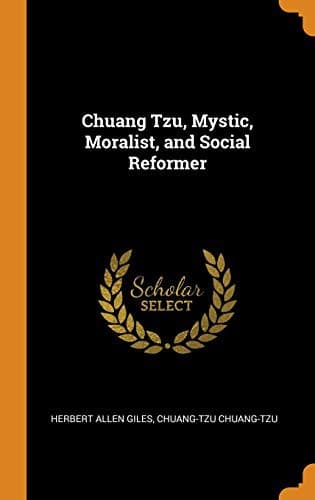
Chuang Tzu: Mystic, Moralist, and Social ReformerZhuangzi
Religion
Chuang Tzu: Mystic, Moralist, and Social Reformer
Zhuangzi
Ethics -- China; Philosophy, Chinese
"Oh, the government of the Sage," answered Chun Mang. "The officials
confine themselves to their functions. Ability is secure of employment.
The voice of the people is heard, and action is taken accordingly.
Men's words and deeds are their own affairs, and so the empire is at
peace. A beck or a call, and the people flock together from all sides.
This is how the Sage governs."
"Tell me about the man of perfect virtue," said Yüan Fêng.
"The man of perfect virtue," replied Chun Mang, "in repose has no
thoughts, in action no anxiety. He recognises no right, nor wrong,
nor good, nor bad. Within the Four Seas, when all profit--that is his
pleasure; when all share--that is his repose. Men cling to him as
children who have lost their mothers; they rally round him as wayfarers
who have missed their road. He has wealth and to spare, but he knows
not whence it comes. He has food and drink more than sufficient, but
knows not who provides it. Such is a man of virtue."
"And now," said Yüan Fêng, "tell me about the divine man."
"The divine man," replied Chun Mang, "rides upon the glory of the sky
where his form can no longer be discerned. This is called absorption
into light. He fulfils his destiny. He acts in accordance with his
nature. He is at one with God and man. For him all affairs cease to
exist, and all things revert to their original state. This is called
envelopment in darkness."
Mên Wu Kuei and Ch'ih Chang Man Chi were looking at Wu Wang's troops.
The famous founder of the Chou dynasty, B.C. 1169-1116.
"He is not equal to the Great Yü," said the latter; and consequently
"we are involved in all these troubles."
"May I ask," replied Mên Wu Kuei, "if the empire was under proper
government when the Great Yü began to govern it, or had he first to
quell disorder and then to proceed to government?"
"If the empire had all been under proper government," said the other,
"what would there have been for the Great Yü to do? He was as ointment
to a sore. Only bald men use wigs; only sick people want doctors. And
the Sage blushes when a filial son, with anxious look, administers
medicine to cure his loving father.
Because to need drugs, the father must first have been sick; and this,
from a Chinese point of view, is clearly the fault of the son.
"In the Golden Age, good men were not appreciated; ability was not
conspicuous. Rulers were mere beacons, while the people were free as
the wild deer. They were upright without being conscious of duty to
their neighbours. They loved one another without being conscious of
charity. They were true without being conscious of loyalty. They were
honest without being conscious of good faith. They acted freely in all
things without recognising obligations to any one. Thus, their deeds
left no trace; their affairs were not handed down to posterity.
Public-domain text, read in full here on John Shaqi.
Reviews
Reviews
No reviews yet
Be the first to share your thoughts on this work.
Elsewhere in the archive
Join the Discussion
Join the discussion
Sign in to leave a comment or review.
Sign InorCreate an account