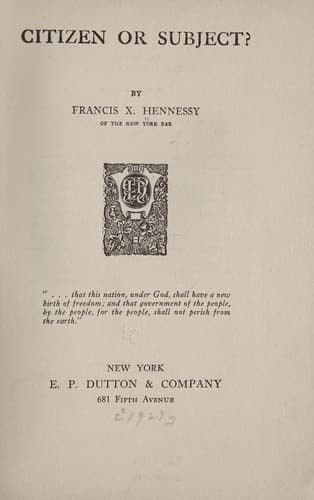
Constitutional history -- United States; United States -- Politics and government; United States. Constitution. 18th Amendment
“When a single government is instituted, the individuals of which it is
composed surrender to it a part of their natural independence, which
they before enjoyed as men. When a confederate republic is instituted,
the communities of which it is composed surrender to it a part of their
political independence, which they before enjoyed as states.... Since
_states_ as well as _citizens_ are represented in the Constitution
before us, and form the objects on which that Constitution is purported
to operate, it was necessary to notice and define _federal_ as well as
civil liberty.... Under these impressions, and with these views, was
the late convention appointed; and under these impressions, and with
these views, the late convention met. We now see the great end which
they proposed to accomplish. It was to frame, for the consideration
of their constituents, one _federal_ and _national_ Constitution ...
a constitution that would insure peace, freedom, and happiness to the
states and people of America.” (2 _Ell. Deb._ 429, _et seq._)
So spoke the great Wilson, beginning his explanation of the proposed
Constitution to the first Americans assembled in the “conventions”
named in the Seventh and Fifth Articles, the Americans in Pennsylvania.
As we listen to him, we remark the insistence upon the fact that the
Constitution to be considered is both a “_federal_ and _national_
Constitution.” And, in strict conformity to this fact, Wilson is
heard explaining the difference between the _federal_ liberty of a
state, controlled by the _federal_ Articles of a constitution, and
the _natural_ liberty of a man, controlled by the _national_ Articles
of a constitution. We listen to him with great interest when he tells
us that this _federal and national_ Constitution has been framed to
insure “peace, freedom and happiness to the states and the people of
America.” In his words we hear the echo of the fact so clearly declared
in the Tenth Amendment, that the _federal_ powers, not delegated in
this Constitution to the new government, are reserved “to the states
respectively,” and the _national_ powers, not therein delegated, are
reserved “to the people” themselves of America.
Public-domain text, read in full here on John Shaqi.
Reviews
Reviews
No reviews yet
Be the first to share your thoughts on this work.
Elsewhere in the archive
Join the Discussion
Join the discussion
Sign in to leave a comment or review.
Sign InorCreate an account