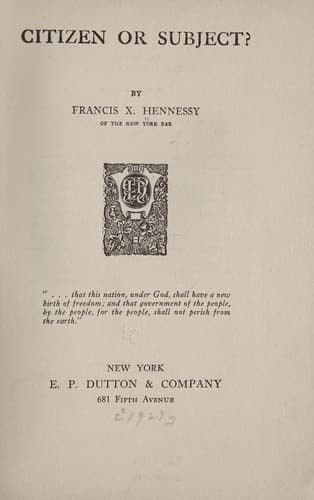
Constitutional history -- United States; United States -- Politics and government; United States. Constitution. 18th Amendment
In the Virginia convention we hear Madison, who drafted and suggested
the Fifth Article at Philadelphia, speak of the important distinction
between the makers of the _federal_ Articles of 1781, only seven years
made, when we sit in that Virginia convention, and the “convention”
makers of the proposed Articles of the new _national_ Constitution.
If these “conventions” make it, he says, it will be a government
established, not through the intervention of the legislatures _but by
the people at large_. Fie goes on to say “In this particular respect,
the distinction between the existing and proposed governments is very
material. The existing system has been derived from the dependent
derivative authority of the legislatures of the _states_; whereas this
is derived from the _superior_ power of the _people_. If we look at the
manner in which alterations are to be made,” now referring directly to
the Fifth Article, “the same idea is, in some degree, attended to.” (3
_Ell. Deb._ 94.)
We feel that it will be quite difficult, when we come later to the
constitutional thinkers of 1917 and 1920, for them to convince us that
Madison meant his Fifth Article to alter “the dependent derivative
authority of the legislatures of the state” and, whenever another
government makes the suggestion, put that dependent authority above
what he calls “the superior power of the people.”
And we feel that these “constitutional thinkers” will find it
impossible to convince us when we recall Madison’s other words,
directly referring to his Fifth Article and the existing power of the
people, mentioned therein by the word “conventions.” These are the
words to which we allude: “Were it [his Fifth Article] wholly national,
the supreme and ultimate authority would reside in the _majority_
of the people of the Union, and this authority would be competent
at all times, like that of a majority of every national society, to
alter or abolish its established government.” It is Madison himself
who puts the one word “majority” in italics. He does so to call
attention to the fact that his Article leaves “the supreme and ultimate
authority” in the _people_ (named as “conventions” in his Article)
but not necessarily capable of exercise by the _majority_ in any
_constitutional_ manner. He goes on to explain this very fact by saying
that when the mode of procedure prescribed in his Article is read, it
is found that “in requiring more than a majority, and particularly in
computing the proportion by _states_, not by _citizens_, it departs
from the _national_ and advances towards the _federal_ character.”
(_Fed._ No. 39.)
Public-domain text, read in full here on John Shaqi.
Reviews
Reviews
No reviews yet
Be the first to share your thoughts on this work.
Elsewhere in the archive
Join the Discussion
Join the discussion
Sign in to leave a comment or review.
Sign InorCreate an account