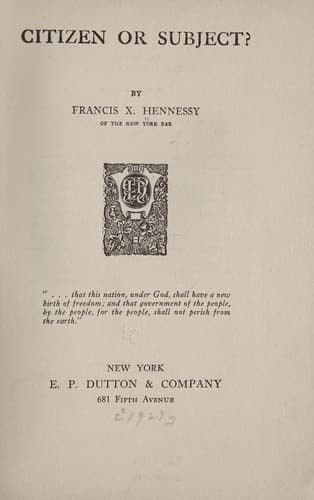
Constitutional history -- United States; United States -- Politics and government; United States. Constitution. 18th Amendment
In New York we find Hamilton, who seconded the suggestion of Madison’s
Fifth Article at Philadelphia, almost immediately after he had stated
that there would be no danger in permitting Congress to _propose_
amendments since “the final decision in the case will rest with the
people.” As we recall, Hamilton said this when the tentative Fifth
Article mentioned no one but the people, “conventions,” as the maker
of future Articles, because he and Madison and their associates at
Philadelphia, whose minds had so far been concentrated upon the
_national_ First Article, had not yet grasped the fact, later stated
by Hamilton to be his conviction, that all future changes would
probably relate “to the organization of government and _not to the mass
of its powers_.” We are, therefore, interested to find Hamilton, in New
York, on Friday, December 14, 1787, pointing out that “It has not a
little contributed to the infirmities of the existing _federal_ system
that it never had a ratification by the PEOPLE. Resting on no better
foundation than the consent of the several legislatures, it has been
exposed to frequent and intricate questions concerning the validity
of its powers.... The possibility of a question of this nature proves
the necessity of laying the foundations of our _national_ government
[the First Article grant of national powers] deeper than in the mere
sanction of delegated authority [referring directly to the state
legislatures which are mentioned in the Fifth Article]. The fabric of
American empire ought to rest on the solid basis OF THE CONSENT OF THE
PEOPLE. The streams of _national_ power ought to flow immediately from
that pure, original fountain of all legitimate authority.” (_Fed._
No. 22.) The capitals are those of Hamilton himself. We rather feel
that his stress upon the “PEOPLE” sharply contrasted with the state
“legislatures,” as the only legitimate direct source of _national_
power, such as is granted in the First Article and the Eighteenth
Amendment, will be somewhat of a shock to the “constitutional thinkers”
of 1917 and 1920. Sitting in the conventions of old, we rather
recognize the capitalized words, where Hamilton says that _national_
power in America “ought to rest on the solid basis of the CONSENT OF
THE PEOPLE,” as a direct echo from the Statute of ’76, enacted only
eleven years before those conventions. That Statute says that every
just power of government must be derived directly from the governed.
Public-domain text, read in full here on John Shaqi.
Reviews
Reviews
No reviews yet
Be the first to share your thoughts on this work.
Elsewhere in the archive
Join the Discussion
Join the discussion
Sign in to leave a comment or review.
Sign InorCreate an account