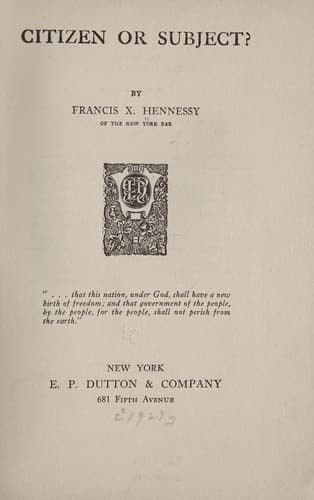
Constitutional history -- United States; United States -- Politics and government; United States. Constitution. 18th Amendment
and did fail to provide any CONSTITUTIONAL method in which government
power to interfere with individual liberty, as all surrendered power
_of that kind_ was distributed between different governments in the
Constitution, could be changed in any way or transferred from one
government to another, unless the “conventions” of the American
citizens _in_ three fourths of the states said “Yes” to any proposed
change or transfer.
The Philadelphia Convention having proposed this particular check upon
the existing ability of the people themselves to oppress individual
liberty, a check which makes the words “by conventions in three fourths
thereof” by far the most important words, the Fifth Article goes on to
prescribe exactly the same check on the exercise of the ability of the
state legislatures to make _federal_ Articles.
That the Fifth Article, a constitutional mode of procedure for the
exercise of two different existing abilities, was _not a grant_ of any
power to the state legislative governments is something that was known
to every man in the conventions which made that Fifth Article.
In the Pennsylvania convention, Wilson plainly stated the knowledge
of all that the supreme power “_resides_ in the people, as the
fountain of government; that the people have not--that the people
meant not--and that the people ought not--to part with it to any
government whatsoever. In their hands it remains secure. They can
delegate it in such proportions to such bodies, on such terms, and
under such limitations, as they think proper. I agree with the members
in opposition, that there cannot be two sovereign powers on the same
subject.... My position is, sir, that, in this country, the supreme,
absolute, and uncontrollable power resides in the people at large.” (2
_Ell. Deb._ 456 et seq.)
When more than half a century had passed, the same thing was known to
those who knew American Constitutional Law.
“It is obviously impossible for the whole people to meet, prepare and
discuss the proposed alterations, and there seems to be no feasible
mode by which an expression of _their_ will can be obtained, except
by asking it upon the single point of assent or disapproval. But no
body of representatives, _unless specially clothed with power for that
purpose by the people when choosing them_, [ergo, no permanent state
governments or legislatures] can rightfully take definitive action
upon amendments or revisions; they must submit the result of their
deliberations to the people--WHO ALONE ARE COMPETENT TO EXERCISE THE
POWERS OF SOVEREIGNTY IN FRAMING THE FUNDAMENTAL LAW--for ratification
or rejection.”
So spoke the great Cooley in reference to making changes in _national_
constitutions in his work on Constitutional Limitations (7th ed., 1903,
at p. 61).
When one hundred and seventeen years had passed since the conventions
in which we just sat, the same thing was known in the Supreme Court, in
1907.
Public-domain text, read in full here on John Shaqi.
Reviews
Reviews
No reviews yet
Be the first to share your thoughts on this work.
Elsewhere in the archive
Join the Discussion
Join the discussion
Sign in to leave a comment or review.
Sign InorCreate an account