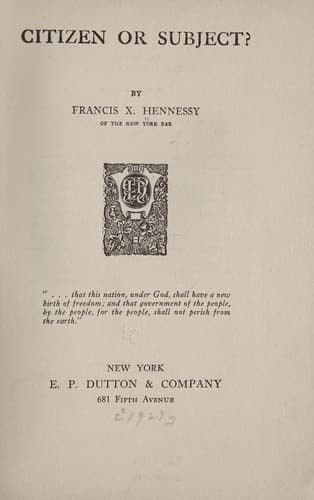
Constitutional history -- United States; United States -- Politics and government; United States. Constitution. 18th Amendment
In its _then_ form it was the suggestion that, after or simultaneously
with the state government exercise of an imaginary power to command
the American citizens, those same state governments should vest in the
only government of American citizens a future ability to make commands
on the same subject, a subject not enumerated in the First Article. The
Statute of ’76, the reasoning and the decision at Philadelphia in 1787
that _its_ First Article could only be made by the “conventions,” the
clear and explicit statements in the Supreme Court (from Marshall to
Brewer in 1907) that no valid grant of _national_ power could ever be
made except by the “conventions,” the prescription in the Fifth Article
of the _constitutional_ mode in which a “Yes” from three fourths of
those conventions would validly make grants of _such_ power--all
these things meant nothing whatever to the Senator from Texas or his
colleagues in Congress, to the legislators in the various states,
to government officials or to the “constitutional” lawyers who have
discussed the Eighteenth Amendment. None of them realized the clear
fact that, if government could get new power over human beings _from
government_, the Americans, through whose education _we_ have lived,
had wholly failed to achieve their one purpose, security of human
freedom from any interference by government except under some power of
interference directly granted by themselves to that government.
Many of the colleagues of the Senator from Texas questioned the
_wisdom_ of asking the grant on that subject. We know not one, however,
who questioned the _ability_ of the proposed donors _to make_ the
grant. We know not one who questioned as a fact that a fractional part
of our state governments have the very omnipotence over the individual
people of all America, which those earlier Americans denied to the
British Parliament. Among _our_ “constitutional” lawyers, there were
many who were engaged to combat in court the validity of the new
Article. They questioned its validity on the ground that it took from
the states, which are mere political entities, part of the power which
each state had not surrendered. In this, they ignored the legal fact,
settled by innumerable decisions, that the people of America, not the
states, made the Constitution and all its grants of _national_ power.
They questioned its validity on the ground that the power (to make
constitutional Articles) “granted” (?) in the Fifth Article did not
include the power to make fundamental changes in the Constitution.
In this, they wholly ignored the certain fact that no such power
_is_ granted in the Fifth Article but that two distinct powers, then
existing, one limited and the other unlimited, are _mentioned and not
granted_ in the Fifth Article, and a mode of procedure for the future
exercise of each is prescribed. In all their challenges to the validity
of the new Article, however, we know not one who ever knew or mentioned
Public-domain text, read in full here on John Shaqi.
Reviews
Reviews
No reviews yet
Be the first to share your thoughts on this work.
Elsewhere in the archive
Join the Discussion
Join the discussion
Sign in to leave a comment or review.
Sign InorCreate an account