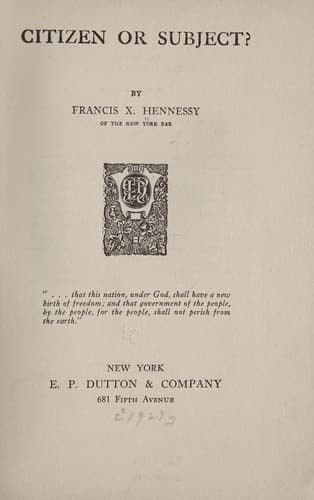
Constitutional history -- United States; United States -- Politics and government; United States. Constitution. 18th Amendment
by governments outside of New York, the Mullan-Gage Law would still
remain a valid statute. This would mean, of course, that the republican
form of government guaranteed to the citizens of New York, by the
Fourth Article, had come absolutely to an end. Our particular query, at
this point, is obviously one of considerable importance to us American
citizens, each of whom happens to be also a citizen of some state to
which the citizens of America made the guarantee of the Fourth Article
and imposed on the very Congress, which originated the Eighteenth
Amendment, the duty of having that guarantee fulfilled.
There are other equally pertinent questions which we might ask about
this unique Section 2 of the Eighteenth Amendment. We will leave them
for the present, so that we may continue the story of the travel of
the proposed new Article through the two Houses of the Congress which
suggested that governments exercise and give government ability to
exercise this new power over American citizens, not enumerated in
the First Article. We come now to the days on which the House of
Representatives and the Senate discussed the Joint Resolution. In the
recorded eloquence of the advocates of the proposal, we shall find
much to remind us of the prevailing attitude in the British Parliament
toward us in 1775. But, in that eloquence, we shall look in vain for
any echo of the Philadelphia of 1787 or of the “conventions” in which
Americans once assembled and gave their only government its only
enumerated powers to interfere with their individual freedom.
CHAPTER XVII
THE TORY IN THE HOUSE
“Let facts be submitted to a candid world.” _They_ have “combined with
others to subject us to a jurisdiction foreign to our Constitution and
unacknowledged by our laws; giving” _their_ “assent to their acts of
pretended legislation;. .. For. .. declaring themselves invested with
power to legislate for us in all cases whatsoever.”
It is doubtful if our Congress of 1917 ever read the above language.
It is certain that such Congress, reading those words, would heed them
just as little as all advocates of the supposed Eighteenth Amendment
have heeded the express commands of the Americans who uttered those
words.
Public-domain text, read in full here on John Shaqi.
Reviews
Reviews
No reviews yet
Be the first to share your thoughts on this work.
Elsewhere in the archive
Join the Discussion
Join the discussion
Sign in to leave a comment or review.
Sign InorCreate an account