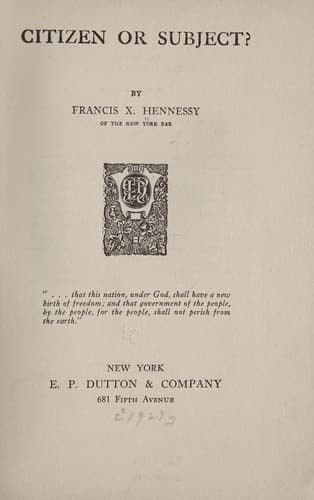
Constitutional history -- United States; United States -- Politics and government; United States. Constitution. 18th Amendment
The more we average Americans consider, however, the Congressional
record of 1917 and the story of the subsequent five years, the more
do we understand the curious mental attitude which has led Webb and
those of his Tory faith, who believe that the new Amendment is in the
Constitution, to think that governments could make that command to and
that grant of power over the citizens of America. Our consideration
leads us to think that none of these men have ever read or grasped
the meaning of the words expressing a knowledge so often shown by our
Supreme Court:
The people who adopted the Constitution knew that in the nature of
things they could not foresee all the questions which might arise in
the future, all the circumstances which might call for the exercise
of further _national_ powers than those granted to the United States,
and after making provision for an Amendment to the Constitution by
which any needed additional powers would be granted, they reserved to
_themselves_ all powers not so delegated. (Justice Brewer, Kansas v.
Colorado, 206, _U. S._ 46 at p. 90.)
We are sorely afraid that Webb and the Congress of 1917 and all
upholders of the new Amendment have made exactly the same vital mistake
which had been made, in that reported case, by the counsel who there
represented the very same government which repeated the mistake in 1917.
That counsel had contended for the proposition that there are
“legislative powers affecting the nation as a whole [the citizens
of America] which belong to, although not expressed in the grant of
powers” in the First Article. The answer of the Supreme Court was
decisive on the mistake of that counsel and the mistake of the 1917
request from Congress to the state governments. The answer was that the
proposition
Public-domain text, read in full here on John Shaqi.
Reviews
Reviews
No reviews yet
Be the first to share your thoughts on this work.
Elsewhere in the archive
Join the Discussion
Join the discussion
Sign in to leave a comment or review.
Sign InorCreate an account