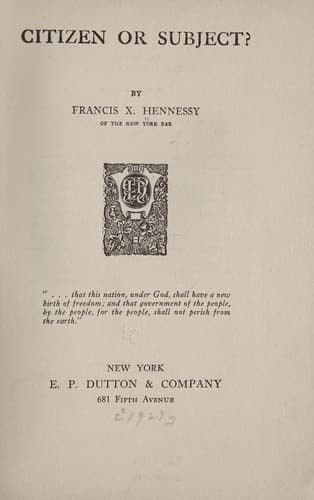
Constitutional history -- United States; United States -- Politics and government; United States. Constitution. 18th Amendment
is in direct conflict with the doctrine that this is a government of
enumerated powers. That this is such a government clearly appears
from the Constitution, independently of the Amendments, for otherwise
there would be an instrument granting certain specified things
made operative to grant other and distinct things. This natural
construction of the original body of the Constitution is made
absolutely certain by the Tenth Amendment. This Amendment, which was
seemingly adopted with prescience of just such contention as the
present, disclosed the wide-spread fear that the National Government
might, under the pressure of a supposed general welfare, attempt to
exercise powers _which had not been granted_. With equal determination
the framers intended that no such assumption should ever find
justification in the organic act, and that if in the future further
powers seemed necessary, they should be granted _by the people_ in the
manner they had provided for amending that act. It reads: “The powers
not delegated to the United States by the Constitution, nor prohibited
by it to the States, are reserved to the States respectively, or to
the people.” _The argument of counsel ignores the principal factor in
this Article_, to wit, “THE PEOPLE.” Its principal purpose was not a
distribution of power between the United States and the States, but a
reservation _to the people_ of all powers _not_ granted. The preamble
of the Constitution declares who framed it,--“We, the people of the
United States,” not the people of one State, but the people of all the
States; and Article X reserves to the people of all the States the
powers not delegated to the United States. The powers affecting the
internal affairs of the States not granted to the United States by the
Constitution, nor prohibited by it to the States, are reserved to the
_States respectively_, and all powers of a national character which
are not delegated to the National Government by the Constitution are
reserved to the _people of the United States_. (206 _U. S._ at p. 89.)
We average Americans know, and Webb and those of his Tory faith cannot
deny, that the power to make the command of Section 1, the power
purported to be granted in Section 2, are among the powers of which the
Supreme Court speaks as reserved, not to the states, but to the people
of America. We also know, and again _they_ cannot deny, that only
those, who have, can give, or grant. For which reason, _we_ ask that
_they_ answer this question: How can the state governments exercise or
grant a power which was not reserved to the states but was reserved by
the citizens of America to themselves?
Public-domain text, read in full here on John Shaqi.
Reviews
Reviews
No reviews yet
Be the first to share your thoughts on this work.
Elsewhere in the archive
Join the Discussion
Join the discussion
Sign in to leave a comment or review.
Sign InorCreate an account