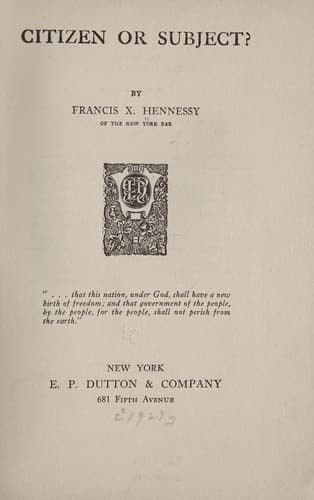
Constitutional history -- United States; United States -- Politics and government; United States. Constitution. 18th Amendment
At last, in this brief, we are getting the clear echo of our own
knowledge that, _until this Statute is revoked_, it is not the right
of “_government or governments_” to institute new government, laying
its foundation on such principles and organizing its powers in such
form as to “governments” shall seem most likely to effect the safety
and happiness “of governments.” Moreover, in this brief, we are getting
the clear echo of our own knowledge that this Statute can _never_ be
revoked, while we remain free men and citizens instead of the subjects
we were until that Statute was enacted.
And when we turn to another brief for a moment, we are cheered to find
the refutation of the Sheppard ignorance of the identity of those who
made _our_ Constitution, “We, the people of” America, in its Preamble
and its most important factor of the Tenth Amendment, the “conventions”
of ourselves in its Seventh and its Fifth Articles. With gratification
that some “constitutional” lawyers still know and observe the important
distinction between the ability of ourselves, the “conventions”
of the Seventh and Fifth Articles, and the lack of ability in the
“legislatures” of the Fifth Article to give to government _national_
powers, we average Americans recognize, in the following challenge
of _this_ brief, the challenge we would have made to the Sheppard
proposition that legislatures attempt to constitute such new government
over us. This is the challenge of the brief to Sheppard: “The
Constitution is not a compact between states. It proceeds _directly_
from the people. As was said by Mr. Chief Justice Marshall in McCulloch
v. Maryland, 4 _Wheat._ 316, etc.” Then follows the Marshall clear
exposition of how the people themselves, the “conventions,” made
the constitution which is the First Article and how, if any other
constitution of that kind, such as the Eighteenth Amendment, is ever
to be made “safely, _effectively_, and wisely” it must be made by
ourselves, assembled in the “conventions” named in the Fifth Article.
The full extract from Marshall has been set out already herein at page
98.
Public-domain text, read in full here on John Shaqi.
Reviews
Reviews
No reviews yet
Be the first to share your thoughts on this work.
Elsewhere in the archive
Join the Discussion
Join the discussion
Sign in to leave a comment or review.
Sign InorCreate an account