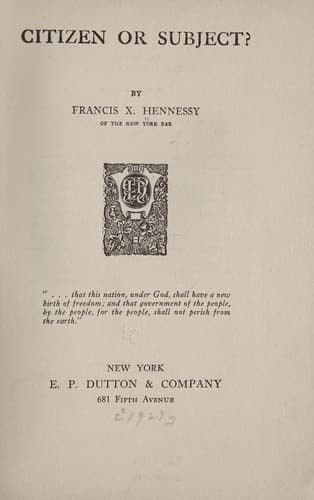
Constitutional history -- United States; United States -- Politics and government; United States. Constitution. 18th Amendment
No brief recognizes that one of the supposed grantees _is_ the
supposed grantor. No brief seems to know that the supposed grantees
were respectively competent makers of certain kinds of Articles even
before the Fifth Article was written at Philadelphia. No brief seems
to know--or to sense the decisive effect of the fact--that, within the
twelve years which immediately preceded the supposed “grant,” each
of the two respective makers of Articles, who are mentioned in the
Fifth Article, had exercised its respective ability to make Articles
_of a certain kind_. No brief seems to know that one of the supposed
grantees, the “conventions,” at the very moment of the supposed
“grant,” was exercising its own unlimited ability to make Articles of
every kind. For all that the briefs disclose, in the decisive effect of
the two facts upon the supposed validity of the Eighteenth Amendment,
the “state legislatures” might never have made the _federal_ Articles
of 1781 and the “conventions” might never have made the _federal_ and
_national_ Articles of 1788.
No brief urges the greatest legal decision made at Philadelphia in 1787
as binding legal authority that the state “legislatures” of the Fifth
Article _never_ can, while the Fifth Article “conventions” _always_
can, make a _national_ Article like the First Article or the Eighteenth
Amendment. One brief does suggest that decision as authority for the
absurd proposition that the Fifth Article mentions no CONSTITUTIONAL
mode in which even the exclusive ability of the “conventions” of the
American citizens can be again exercised to make Articles like the
First Article and the Eighteenth Amendment. In urging that absurd
proposition, the briefer wholly ignores the fact that the Philadelphia
Convention, which made that legal decision, reached its conclusion by
ascertaining what were and still are the _respective_ abilities (to
make Articles) of the state “legislatures” and the “conventions,” both
of which are named as future makers in the Fifth Article.
No brief recognizes the fact (or urges any argument based upon it) that
the Constitution _is_ both a _federal_ and a _national_ Constitution.
For which reason, no brief points out that the Tenth Amendment
expressly reserves the ability to make _federal_ Articles to the state
“legislatures” and the exclusive ability to make _national_ Articles
to the “conventions.” For which reason, no brief points out that each
of the two reservees, named in the Tenth Amendment, is mentioned
separately in the Fifth Article as a possible maker of future articles,
whenever a proposed future Article is of the kind which the existing
ability of the proposed maker is competent to make.
No brief, _against_ the new Amendment, challenges the sheer and absurd
assumption that the Fifth Article _is_ a “grant.” No brief, _for_ the
new Amendment, offers or suggests the slightest fact in support of that
sheer assumption.
Public-domain text, read in full here on John Shaqi.
Reviews
Reviews
No reviews yet
Be the first to share your thoughts on this work.
Elsewhere in the archive
Join the Discussion
Join the discussion
Sign in to leave a comment or review.
Sign InorCreate an account