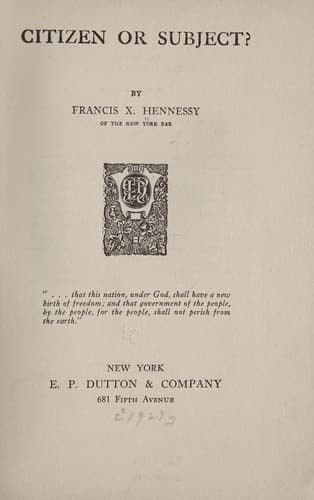
Constitutional history -- United States; United States -- Politics and government; United States. Constitution. 18th Amendment
If forbearance were the sole rule for conduct, if conscience permitted
us to ignore the great danger to our own _individual_ freedom in
_every_ matter, we would be absolutely silent as to the contents of all
those briefs. But, that the _supposed_ presence of the new _national_
Article in the _national_ Constitution of a free people may never be a
precedent for other _government_ making of _national_ Articles, it is
our duty to learn and state what those briefs all disclose.
Not one of them recognizes the identity of the “conventions” of the
Fifth Article with the “conventions” of the Seventh. And all ignore the
identity of the Fifth Article “conventions” with “We, the people” of
America, in the Preamble, and with the most important reservee of the
Tenth Amendment, “the people” of America.
Every argument, whether for or against the new _national_ article,
is based upon the sheer and absurd assumption that the “conventions”
in their Fifth Article _did_ make a _grant_ to themselves, the
“conventions,” and to the state governments. The advocates of the new
Article assume that the “conventions” _granted_ to themselves and to
the state governments _all_ the inalienable omnipotence of the American
people themselves, in their aggregate capacity as the citizens of
America, the very omnipotence the supposed grantors were exercising
when they made the Fifth Article. The opponents of the new _national_
Article assert the absurd assumption of a “_grant_,” but contend for
diverse reasons--remarkable by reason of the fallacy of a “_grant_”
on which each rests--that the “conventions” grant to themselves _only
a part_ of the omnipotence which they already had and were exercising
when they made the supposed “grant.” On which theory, they urge that
the supposed “grant” to the state governments, being identical with
the supposed “grant” to the grantors themselves, is _only part_ of the
omnipotence which the grantors already had and does not include ability
to make Articles like the Eighteenth Amendment.
Not one of these briefs recognizes or urges that the Fifth Article
is not a “grant” of ability _to make_ Articles whether _federal_
or _national_. No brief knows the Fifth Article to be simply the
ratification, by the whole American people, of a hitherto revolutionary
mode of procedure as the future CONSTITUTIONAL mode in which may be
exercised either the existing and limited ability of state legislatures
to make _federal_ Articles or the existing and unlimited ability of the
“people” (the “conventions”) to make _any_ Articles. No brief either
recognizes or urges the absurdity of the thought that the “conventions”
intended to grant or did grant to themselves, the “conventions,” any
part of the omnipotence which the supposed grantors were actually
exercising when making the supposed grant.
Public-domain text, read in full here on John Shaqi.
Reviews
Reviews
No reviews yet
Be the first to share your thoughts on this work.
Elsewhere in the archive
Join the Discussion
Join the discussion
Sign in to leave a comment or review.
Sign InorCreate an account