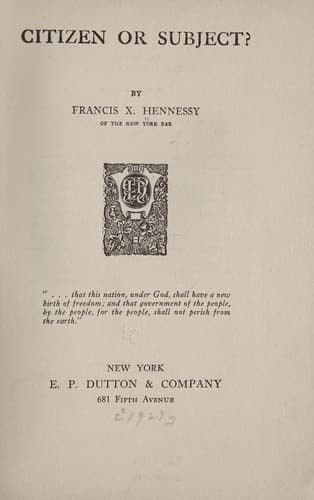
Constitutional history -- United States; United States -- Politics and government; United States. Constitution. 18th Amendment
This is what Hamilton had to say on the danger to liberty, if permanent
state legislative governments, instead of special American delegates
chosen for that purpose, should even elect the American President:
“The mode of appointment of the Chief Magistrate of the United States
is almost the only part of the system, of any consequence, which has
escaped without severe censure, or which has received the slightest
mark of approbation from its opponents.”
(Incidentally we recall that the mode of procedure, which is the Fifth
Article, never received one word of censure from any opponent on any
ground, except that it left _to government_ the ability to reassemble
the “conventions” of the people. It was claimed that, even if the
people found the First Article power oppressive to their individual
freedom, government would never reassemble their “conventions” for the
purpose of permitting them to withdraw any of those grants.)
Hamilton proceeded as follows: “It was desirable that the sense of the
people should operate in the choice of the person to whom so important
a trust was to be confided.”
(We average Americans remember that the trust of making or refusing new
power to interfere with individual freedom would always be infinitely
more important.)
“This end will be answered by committing the right of making it,
not to any preestablished body, but to men chosen by the people for
the special purpose, and at the particular conjuncture.... A small
number of persons, selected by their fellow citizens from the general
mass, will be most likely to possess the information and discernment
requisite to such complicated investigations. It was also peculiarly
desirable to afford as little opportunity as possible to tumult and
disorder.... The precautions which have been so happily concerted in
the system under consideration, promise an effectual security against
this mischief.... And, as the electors,” like the conventions for
granting or refusing national power, “chosen in each State, are to
assemble and vote in the State in which they are chosen, this detached
and divided situation will expose them much less to heats and ferments,
which might be communicated from them to the people, than if they were
all to be convened at one time, in one place.”
(We recall Marshall’s echo of this in his later statement, speaking of
the Fifth and Seventh Article “conventions,” “No political dreamer was
ever wild enough to think of breaking down the lines which separate
the states, and of compounding the American people into one common
mass. Of consequence, when they act, they act _in_ their states. But
the measures they adopt do not, on that account, cease to be the
measures of the people themselves, or become the measures of the state
governments.”)
Public-domain text, read in full here on John Shaqi.
Reviews
Reviews
No reviews yet
Be the first to share your thoughts on this work.
Elsewhere in the archive
Join the Discussion
Join the discussion
Sign in to leave a comment or review.
Sign InorCreate an account