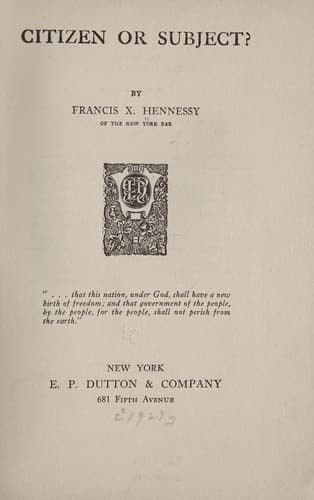
Constitutional history -- United States; United States -- Politics and government; United States. Constitution. 18th Amendment
_Why_ none of these briefs did make this challenge became known to us
when Rice of Rhode Island, with the silence of his colleagues marking
their approval, answered the Court that the new Article could not be
_constitutionally_ made. _Why_ they did not make the challenge will be
emphasized when we read the leading brief against the new Amendment.
Over fifty times it will admit and state that the Fifth Article _is_
a “_grant_” of power to _state_ legislatures from _American_ citizens
and claim the “_granted_” power is a limited power and does not include
ability to make an Amendment like the Eighteenth because such Amendment
takes away the reserved power _of a state or political entity_. Then,
to emphasize what it does not know about the “conventions” of the Fifth
Article and the reserved powers of the citizens of America, this brief
will go on to tell us that there is no _constitutional_ mode in which
can be made an Article which takes more power away from any state;
that such an Article may only be made, outside any _constitutional_
mode, by having the people themselves rescind “the social compact”
which is their American Constitution and having them make “such new
compact as they please”; but that such new compact, such new Article
of that kind, cannot “be validly and legally made to come to pass
against the objection and protest of _any_ state.” All this clearly
explains _why_ none of the briefers were able to answer correctly
the question asked by the Court. How could they tell the Court in
_what_ way the Eighteenth Amendment could be _constitutionally_ made,
when all of them “knew” that there was no _constitutional_ mode
in which the “conventions” of the American citizens could make it,
and when they “knew” that it could not be made, even outside the
Constitution, without the consent of the citizens of _every_ state? The
most important words in the Fifth Article, “in conventions in three
fourths thereof,” did not mean to these briefers what they meant to
the Americans who made the Fifth Article or to Madison and Hamilton
who wrote the Fifth Article and suggested it at Philadelphia. In
the word “conventions,” they did not recognize the Seventh Article
“conventions” of the American citizens describing themselves by exactly
the same word, “conventions,” in the Fifth Article. In the words “in
three fourths thereof” after the word “conventions,” they did not
recognize the great security to human freedom which we have learned
with the Americans who wrote and who made the Fifth Article. They did
not recognize how the American people, by these words, made it _their_
constitutional command that they themselves, again assembled in their
conventions, by a “Yes” from three fourths of their “conventions” _and
without_ the consent of the Americans in the other “conventions,” might
withdraw any power granted in the First Article and might add any new
power to its enumerated grants, whenever _they_ deemed such withdrawal
Public-domain text, read in full here on John Shaqi.
Reviews
Reviews
No reviews yet
Be the first to share your thoughts on this work.
Elsewhere in the archive
Join the Discussion
Join the discussion
Sign in to leave a comment or review.
Sign InorCreate an account